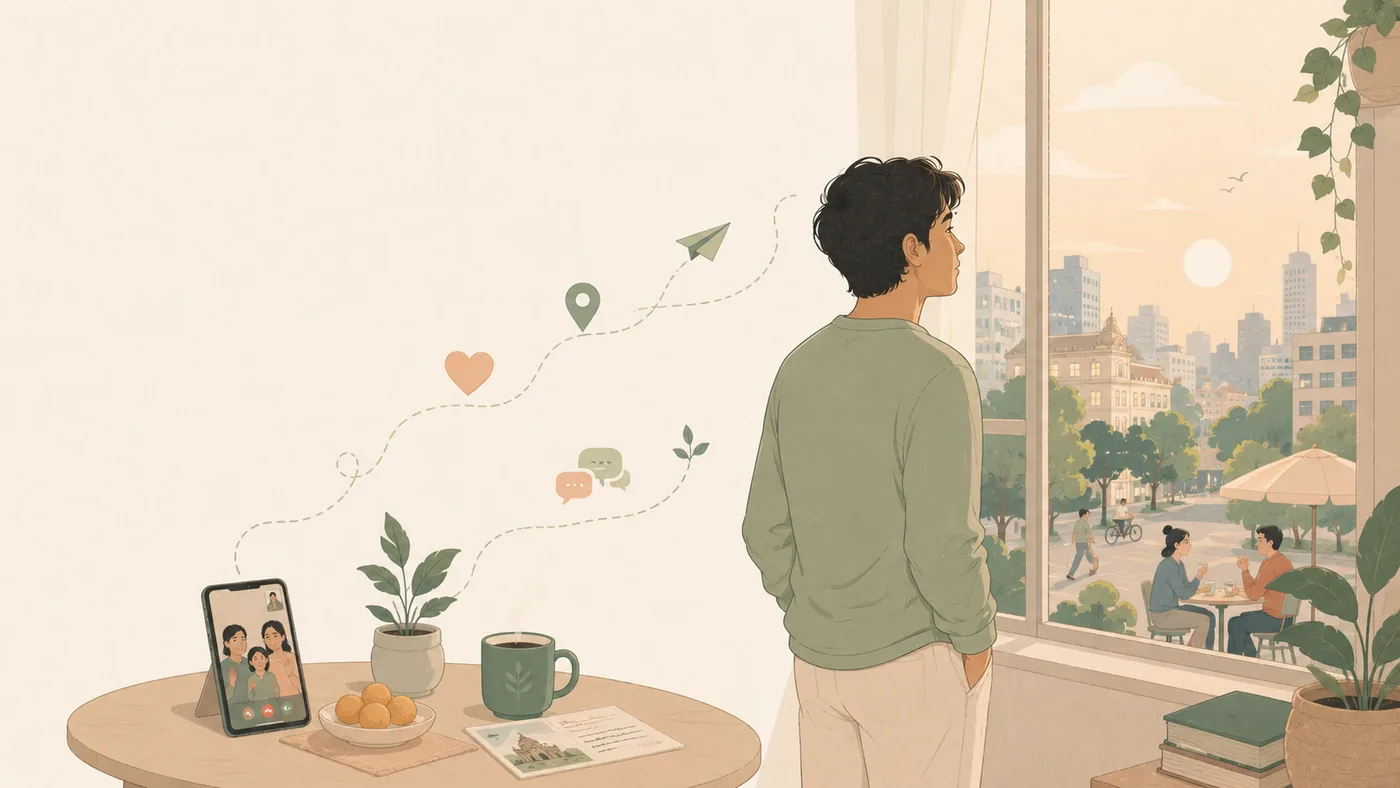
When Arjun was twelve years old, he could not wait to be twenty-five. Twenty-five, in his imagination, was a fully illuminated place. You had a career you believed in. You knew which kind of person you were. You ordered coffee with the easy confidence of someone who had made peace with the world. You did not lie awake at night wondering if your choices made any sense.
Twenty-five arrived. Arjun had a job, an apartment, a group of friends he genuinely liked, and a creeping, persistent sensation that he was doing everything slightly wrong in ways he could not precisely articulate.
The confidence he had imagined — the settled, certain adulthood — had not materialised. Instead, he found something nobody had warned him about: a strange in-between feeling, as though he was simultaneously too old to be lost and too young to have found himself.
He is not alone in this. Not remotely.
The Map We Were Promised
Growing up is sold to children as a destination. Somewhere along the way, we absorb the idea that adulthood is a place you arrive at, and that upon arrival, the questions quiet down. You know who you are. You know what you want. The uncertainty that plagued your teenage years gives way to confidence, clarity, and a life that resembles the brochure.
This is, of course, not remotely true. But we do not discover this until we are already standing in the middle of our own lives, looking around for a map that does not exist.
The uncomfortable truth that nobody prepares us for is this: growing up is not a destination. It is a permanent process. The questions do not stop — they evolve. Who am I? becomes What kind of person do I want to be? What do I want? becomes What do I actually need? The uncertainty does not disappear; it simply changes shape.
"The strange thing about growing up is that nobody tells you it will feel like you are always in the middle of it — never quite arrived, never quite beginning."
Priya was twenty-two when her closest group of school friends began to scatter in different directions. Some moved abroad. Some got married. Some simply grew into people she no longer recognised as the people she had known. The friendships she had assumed were permanent turned out to be deeply context-dependent — they had flourished in a particular time and place, and when that time and place dissolved, so, quietly, did the friendships.
"Nobody told me about this part," Priya said, years later. "Nobody told me that growing up sometimes means grieving people who are still alive."
The Grief Nobody Names
There is a specific, unusual sadness that accompanies growing up, and it is rarely acknowledged because it does not fit neatly into the categories of grief we recognise. It is not the grief of losing someone who has died. It is the grief of chapters that close without announcement — of ordinary moments whose significance you only understand in retrospect.
The last evening you played in the street with your childhood friends, not knowing it was the last time. The final family dinner before life took everyone to different cities. The ordinary Tuesday when your mother helped you with something, and neither of you knew it was the last time she would need to.
These moments pass unmarked. Life does not pause and say: pay attention, this is ending. And so we hurry through them, saving our attention for what we imagine will be more significant moments ahead — and then find ourselves, years later, aching for the ones we were too busy to notice.
Kabir was thirty-one when he drove past his childhood home, now painted a different colour and occupied by a different family. He sat in the car for a long time. Not because anything catastrophic had happened. But because it struck him, with a force he had not expected, that the boy who had lived there was gone. The house remained. The person had become someone else entirely.
This is the grief of growing up: not the loss of what was taken, but the slow, voluntary surrendering of who we used to be.
And it is entirely normal. It is, in fact, evidence that we lived fully enough in those earlier versions of ourselves to miss them when they pass.
The Impossible Expectation of Certainty
One of the most unhelpful myths about adulthood is that it should feel certain. We absorb, somewhere in our upbringing, the idea that confident adults know what they are doing — and that if we do not know what we are doing, something has gone wrong with us specifically.
The reality, as anyone who is honest about their inner life will tell you, is that most adults are navigating significant uncertainty most of the time. They have simply developed the capacity to act despite the uncertainty — or they have become skilled at concealing it. But the uncertainty itself does not vanish.
The comparison trap — so visible in an era of social media — compounds this profoundly. When we scroll through the highlight reels of other people's lives, we are comparing our unedited interior experience to their curated exterior. We see their promotions and their weddings and their holidays and their confident smiles. We do not see their 2 a.m. doubts, their relationship tensions, their career anxieties, or the afternoons they spent wondering if their choices made sense.
"We are comparing our internal experience — messy, uncertain, unedited — to everyone else's external presentation. It is the most unfair comparison in the world."
Nisha was twenty-eight and felt, in her own words, "completely behind." Her university peers seemed to be advancing in careers, getting married, buying homes. She was between jobs, freshly out of a relationship, and sharing a flat with two strangers. "Everyone has figured it out except me," she would tell herself.
What Nisha could not see — what none of us can see from the outside — was that several of the people she was comparing herself to were privately struggling just as much as she was. The colleague whose promotion she envied was paralysed by imposter syndrome. The friend who had just gotten married was already questioning the relationship. The flat-owner who seemed so settled had not spoken honestly to anyone in months.
Certainty, from the outside, is extraordinarily convincing. From the inside, it is extraordinarily rare.
The Art of Letting Go
If there is a single skill that growing up demands more than any other, it is this: the ability to let go. Not passively, not reluctantly, but with enough wisdom to understand that what you release creates the space for what comes next.
You let go of old friendships that have run their course. You let go of dreams that no longer fit who you are becoming. You let go of earlier versions of yourself — the people you were at fifteen, at twenty, at twenty-five — even as you carry everything you learned from being them.
You let go, perhaps most painfully, of the idea that life will follow a predictable arc. That if you do the right things in the right order, outcomes will be reliable. Growing up teaches us, gradually and sometimes painfully, that life has very little interest in scripts.
Meera had spent five years building a career in finance — not because she loved it, but because it was what she had been told to want. At twenty-nine, she left. Her parents were worried. Her peers were baffled. She herself was terrified. Three years later, running a small creative studio she had built from nothing, she described the decision as the first time she had chosen herself over the story she had been handed.
There is no clean version of this process. Letting go is uncomfortable. It asks us to move without guarantees, to trust without certainty, to choose without knowing whether the choice will prove wise. But it is also, consistently, where growth lives.
What we hold onto out of fear does not protect us. It simply delays the learning.
You Were Always Becoming
Perhaps the most important thing nobody tells us about growing up is this: you have never been behind. There is no timeline you have fallen short of, no destination you were supposed to reach by a particular age, no version of adulthood you were obligated to inhabit by any given birthday.
Growing up is not a race you are losing. It is a landscape you are learning to navigate. And the pace at which you navigate it is, entirely and without exception, your own.
Arjun, from our opening, is thirty-two now. He has changed jobs twice, changed cities once, and changed his understanding of who he is more times than he can count. He still wakes up some mornings with questions he cannot answer. He still has days that feel like standing in fog.
But he has also learned something he could not have known at twenty-five: that the confusion was not a sign that he was failing to become someone. It was evidence that he already was.
"Growth is not what happens when the uncertainty resolves. It is what happens inside the uncertainty, every time you choose to keep going anyway."
Nobody told you growing up would feel like this — uncertain, nonlinear, full of grief and beauty and questions without clean answers. Nobody told you that some of the most significant moments would be ordinary ones you failed to notice at the time. Nobody told you that confidence is something you build in the doing, not something you receive upon reaching a certain age.
But here you are, in the middle of it. Still asking questions. Still moving. Still becoming.
And that, though nobody may have told you, is exactly what growing up looks like from the inside.