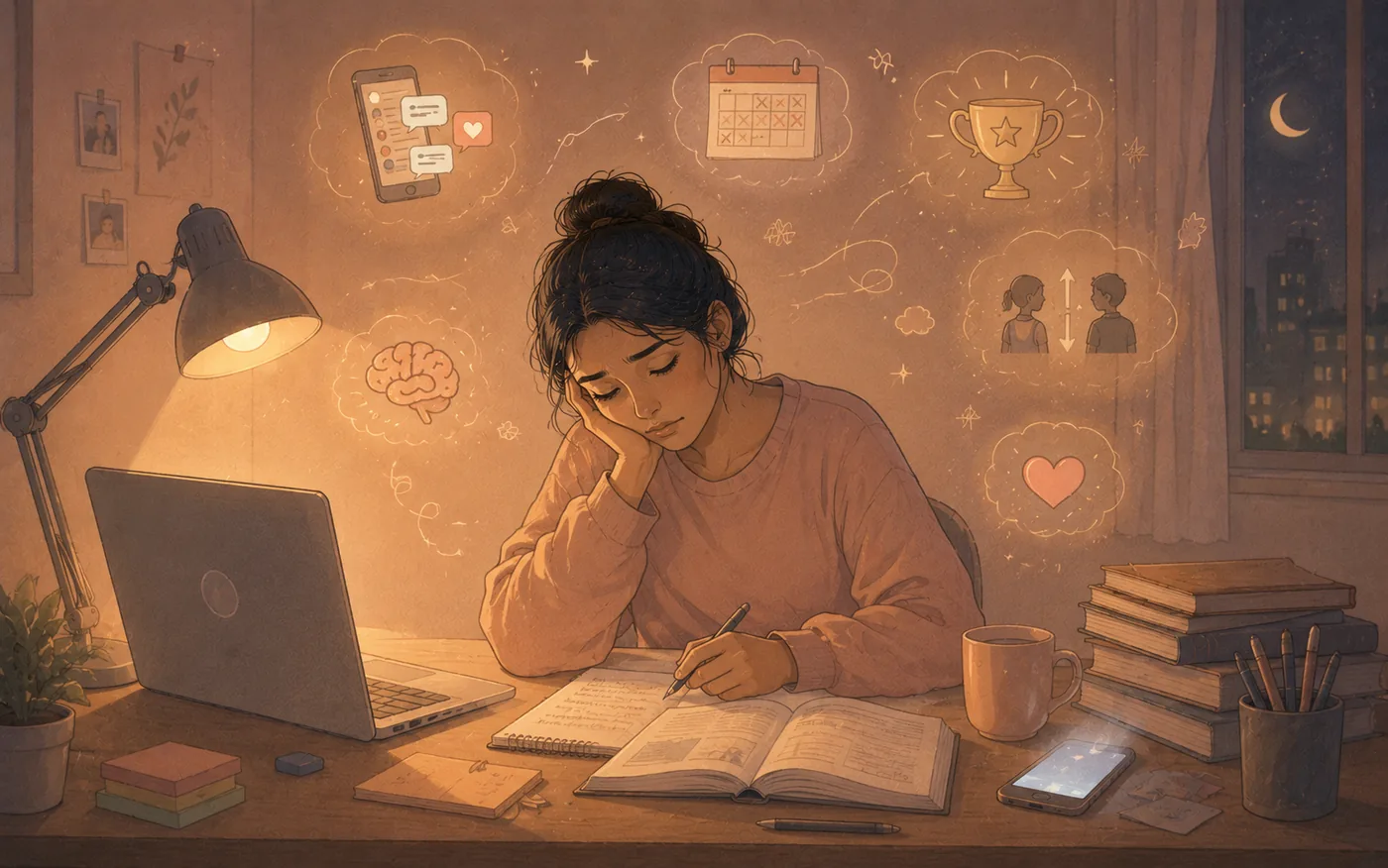
Seventeen-year-old Aanya had not slept past six-thirty on a school day in three years. By eight, she was on a crowded train. By half past eight, she was in the first of six classes. Between classes, she rehearsed lines for the school play, checked in on a group assignment, ate lunch in twelve minutes, attended a student council meeting, and answered thirty-seven messages in three different group chats. She returned home at six, opened her laptop, and worked until midnight.
Her mother, watching her from the doorway, thought she is lucky to be so busy. All these opportunities. What a life.
What her mother could not see — what Aanya herself could barely articulate — was that her daughter was running on empty. Not tired the way you are after a long, good day. Tired in a deeper way. A way sleep alone could not touch.
This is the exhaustion that millions of teenagers around the world carry quietly, and that the adults in their lives consistently misread.
The Wrong Diagnosis
When teenagers express exhaustion, the responses they most commonly receive follow a recognisable pattern. "You're on your phone too much." "Go to bed earlier." "At your age I was working twice as hard." "You have nothing to be tired about."
These responses are not entirely without basis. Sleep deprivation is genuinely prevalent among adolescents, and research consistently links inadequate sleep to mood disturbance, impaired concentration, and reduced resilience. But they are answers to the wrong question, and they skip past the teenage stress causes that actually explain the tiredness. They address the symptom while leaving the cause entirely unexamined.
Because the exhaustion most teenagers are experiencing today is not primarily about sleep. It is about mental and emotional labour — the relentless, largely invisible work of managing performance, identity, comparison, and expectation in an environment that offers very little genuine rest.
"We ask teenagers to be high-performing, self-directed, emotionally regulated, socially sophisticated, and future-ready — all simultaneously, at an age when the brain is still developing the architecture to do any of these things."
The question we need to be asking is not why teenagers are so tired. It is what, specifically, is making them that way.
The Weight of the Scoreboard
Consider what a typical ambitious teenager's internal landscape looks like in contemporary India — or in most urban societies worldwide.
There is the academic performance pressure: the grades that must not only be good but excellent, the percentile that determines which college, which college that determines which career, which career that determines which life. The stakes are presented as enormous and the margin for error as vanishingly small — from a remarkably early age.
There is the extracurricular performance pressure: not just attending activities but excelling at them, documenting them, building them into a narrative that sounds impressive on an application. Hobbies are no longer permitted to simply be enjoyed. They must be productive. Sport must produce achievement. Art must produce recognition. Passion must produce a portfolio.
Rohan was fifteen and loved photography. He would spend hours on weekend mornings with his father's old camera, photographing ordinary things: the chai stall on the corner, the geometry of shadows on a wall, his grandmother's hands. Then someone suggested he enter competitions. Then someone said his photos could strengthen his college application. Then he started photographing things that would win awards rather than things that moved him. Within a year, photography had become another responsibility. He had not photographed anything purely for himself in six months.
This transformation — of joy into performance — is one of the most corrosive quiet processes in a teenager's life. It does not announce itself. It happens gradually, request by request, until the things that were once replenishing become depleting.
And when everything is performance, there is no actual rest. There is only preparation for the next thing.
The Never-Ending Mirror
Previous generations experienced social comparison within bounded, local contexts. You compared yourself to classmates you could see and know personally. The comparison was real, sometimes painful, but it had edges.
Today's teenagers compare themselves to the entire internet. Every scroll of a feed presents curated evidence that someone their age is achieving more, appearing more confident, living a more aesthetically compelling life. The friend who seems to have everything figured out. The stranger with fifty thousand followers and a clarity of purpose that feels impossibly far away.
Most teenagers are sophisticated enough to understand, intellectually, that social media presents a filtered reality. But intellectual understanding and emotional experience are not the same thing. The prefrontal cortex — the part of the brain responsible for perspective-taking, long-term reasoning, and emotional regulation — is not fully developed until the mid-twenties. Teenagers experience social comparison with an emotional intensity that adults have largely grown past, and they experience it now at a scale and frequency that simply has no historical precedent.
"There is no off switch. The comparison follows them home, into their bedrooms, into the last moments before sleep. The scoreboard never goes dark."
A teenager in 2024 navigating a difficult friendship does not leave that difficulty at the school gate. It continues in group chats, in comment sections, in the read receipts on messages sent and ignored. The social landscape does not pause when the school day ends. It simply moves to a different screen.
This means that adolescent social and emotional labour is now genuinely continuous in a way it has never been before. The brain is never fully off duty. And a brain that is never off duty is, over time, a brain that is perpetually exhausted.
First Times Are Hard
There is another dimension of teenage exhaustion that adults tend to underestimate, perhaps because their own memory of it has softened with time: the sheer energy required to experience significant things for the first time.
When an adult navigates disappointment, they bring with them a history of having navigated disappointment before and survived. The experience is painful, but it is placed within a context of resilience already proven. When a teenager experiences the same disappointment, they have none of that history. They are encountering it raw.
The first time a close friendship ends. The first significant failure. The first experience of being excluded. The first encounter with genuine uncertainty about who they are or who they want to become. These experiences require enormous emotional processing precisely because they are new — because the person experiencing them has no established framework for understanding that they will pass, or what to do with them while they are happening.
Nisha was sixteen when her best friend of eight years gradually withdrew from her without explanation. There were no fights, no confrontations — just a slow, inexplicable cooling. Nisha spent weeks trying to understand what she had done wrong, what she could fix, what had changed. She told her parents she was fine. She lost four kilograms in two months. She stopped laughing at things that used to amuse her. Her teachers noted that she seemed distracted. Nobody connected the dots.
The emotional weight of first times is compounded by the fact that teenagers are often expected — implicitly or explicitly — to handle these experiences without making too much of them. To be resilient. To bounce back. To not let it show.
The energy required to carry significant pain quietly is, in itself, exhausting.
The Guilt of Stopping
Perhaps one of the most telling signs of how adolescent culture has shifted is the phenomenon of teenagers feeling guilty for resting. Not because they have been explicitly told they cannot rest, but because they have absorbed, from a thousand subtle signals, the idea that productivity is virtue and rest is its absence.
Free time, in this landscape, becomes uncomfortable. The teenager who sits in their room reading a novel for an afternoon, or who spends a Saturday doing nothing in particular, has learned to experience this as a failure of ambition rather than a legitimate human need. They reach for their phones not because they are particularly interested in their feeds but because doing something — even something meaningless — feels safer than the accusation of doing nothing.
Rest has been reframed as laziness. Play has been reframed as time that could have been spent preparing. And in that reframing, one of the most fundamental human requirements has been quietly pathologised.
"Rest is not a reward teenagers must earn by performing sufficiently. It is a biological and psychological necessity — as essential to their development as any lesson they will learn in a classroom."
The irony is profound: a teenager who genuinely rests — who reads for pleasure, who lies in the garden watching clouds, who spends an unhurried afternoon with people they love — is building exactly the internal resources that will sustain long-term wellbeing and achievement. A teenager who runs without stopping, out of guilt or pressure, is spending those resources faster than they can be replenished.
We are producing a generation that is expert at performing wellness while experiencing depletion.
What They Actually Need
Most of the teenage stress factors described above are not things a young person can switch off by themselves — which is exactly why the response has to come from the adults around them.
The question that matters most is not what teenagers should do differently. It is what the adults in their lives — parents, educators, policymakers, therapists — should understand differently. Schools have a part to play as well: life-skills and socio-emotional learning in schools can give teenagers the words for what they are carrying, and adults a better way to listen.
They need their exhaustion to be taken seriously rather than dismissed. The teenager who says "I'm tired" is rarely describing a deficit of sleep alone. They are describing a system running beyond its sustainable capacity. The appropriate response is not to recommend an earlier bedtime. It is to ask, with genuine curiosity: what is making you tired? And then to listen — not for a problem to solve, but for an experience to understand.
They need permission to be unproductive. Not all the time, not as a permanent posture, but regularly and without guilt. Play — purposeless, unscheduled, intrinsically motivated activity — is not a childhood luxury that should be phased out at adolescence. It is how human beings at every age replenish the cognitive and emotional resources that sustained effort depletes.
They need the comparison culture to be named and examined rather than assumed. Conversations about social media that begin and end with "you're on it too much" miss the point. The more useful question is what they are experiencing when they are on it — and whether the adults in their lives are modelling a healthier relationship with comparison themselves.
Aanya, from our opening, eventually told her school counsellor what she had not been able to tell her parents: that she had not felt genuinely rested in over a year. That she woke up each morning already behind. That she was performing competence she did not feel. The counsellor listened for forty minutes without offering a single solution. At the end, Aanya said: "I didn't know I needed someone to just hear this." She had not needed advice. She had needed to be believed.
Behind the tired eyes and the clipped responses and the afternoons spent staring at ceilings, there is a person navigating one of the most complex and significant periods of human development — doing so with more external pressures and less genuine rest than perhaps any previous generation.
The exhaustion is real. It is not laziness. It is not ingratitude. It is not a character flaw.
It is evidence of someone doing their best to keep up with a world that is asking a great deal of them — and evidence, too, that we owe them something more than discipline and a lecture about early bedtimes.
We owe them our attention. Our belief. And the simple, radical act of asking: how are you, really? And meaning it.