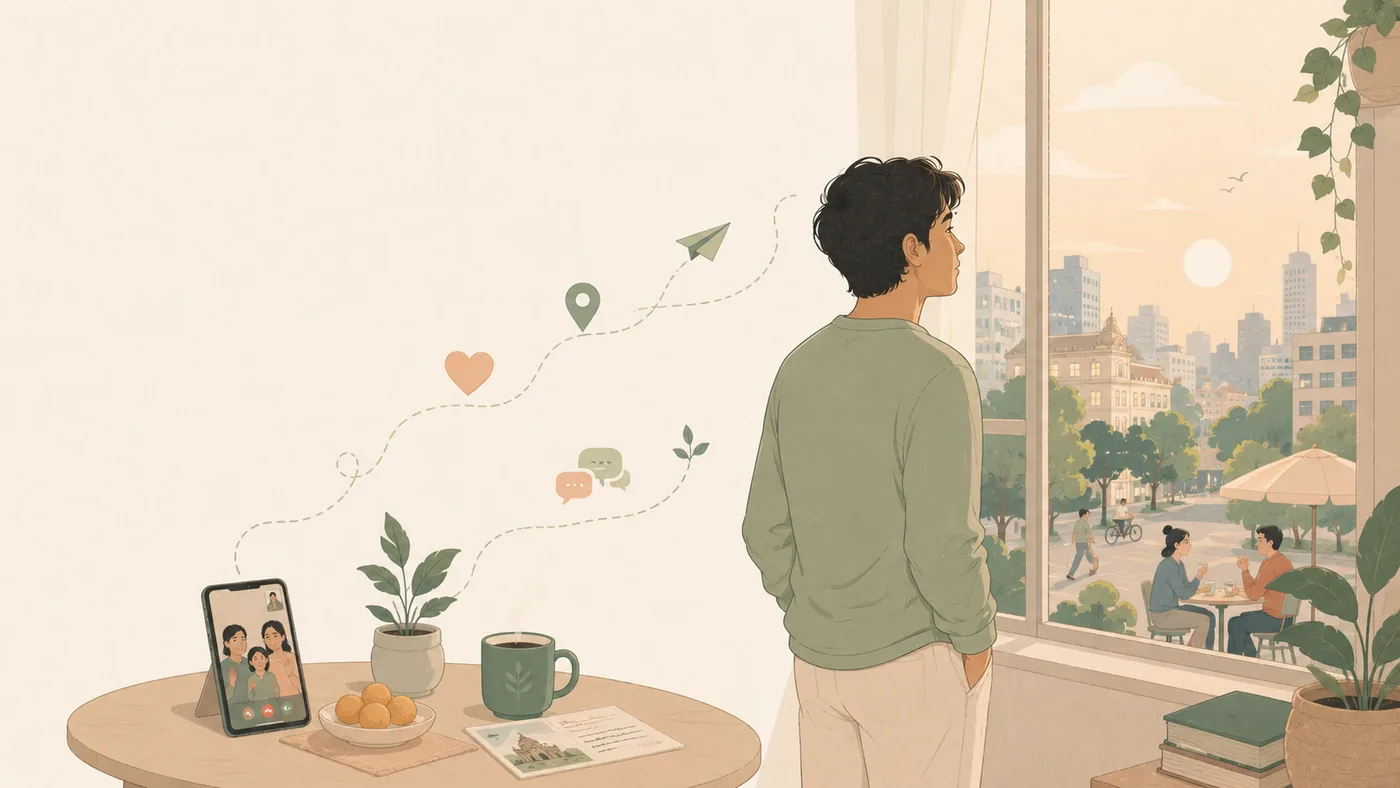
There is a unique excitement that comes with moving to another country. I for one know I was over the moon. Whether the journey is undertaken for education, career advancement, or a fresh start, living abroad can become one of life's most transformative milestones. Yet beneath that initial excitement lies another reality, one that is discussed far less often.
For many international students and young professionals, adapting to a new culture can be emotionally overwhelming during the first weeks or months. The unfamiliar language, different food, changing weather, new institutional systems, and the heavy absence of familiar faces can quietly create an undercurrent of loneliness, homesickness, and isolation, of which many tend to ignore.
These feelings are not signs of weakness. They are a natural, predictable psychological response to entering a world where almost nothing yet feels like yours.
When Everything Feels Unfamiliar: Navigating Acculturative Stress
Think about your life back home. You move on autopilot. You know exactly how to order street food, you get the local jokes without trying, and you cross the street without thinking twice. When you relocate, that autopilot breaks completely. Every single mundane task suddenly requires massive, conscious mental energy.
Psychologists call this transition acculturation, and the mental fatigue that comes with it is known as acculturative stress. This stress is not simply a by-product of discomfort; it is a measurable phenomenon with documented effects on mental health, academic performance, and social functioning (Smith & Khawaja, 2011). But out here on the ground it just feels like exhaustion.
To better understand this concept, we must first look at the following scenarios:
Scenario 1: The Grocery Store Incident
A first-year student from Zimbabwe walked into a local market during his first week. Back home, buying groceries was an effortless 10-minute task. But here, surrounded by unfamiliar brands, and a currency conversion math problem running in his head, he felt conflicted. He ended up buying overpriced goods and food that he couldn't even eat.
Scenario 2: The Geography Disconnect
Another student shared the pain of the "time zone gap." She had a rough, isolating day at the lab and just wanted to talk to her mother. But when she checked her phone, it was 2:00 AM back home. She couldn't call without waking her family, and she didn't want to text and make them worry from thousands of kilometers away. So, she sat in the quiet of her room, carrying the weight alone.
The Emotional Weight of Homesickness and "Loneliness in a Crowd"
Homesickness is frequently misunderstood. Many assume it simply means missing a geographic location. In reality, homesickness is a deep longing for familiarity; for the texture of a life that required no explanation.
It's missing the exact texture of comfort food whose flavours are simply integrated into your childhood memories. It's missing conversations where idioms land perfectly without you having to rephrase your sentences three times. It's missing the streets you knew by heart and the people who knew your character before you ever had to introduce yourself.
When you don't have that, you experience "loneliness in a crowd". You can stand in the middle of a bustling university campus or a massive corporate office surrounded by thousands of people, yet feel totally unseen. The issue isn't a lack of human beings nearby; it's the temporary absence of a meaningful, mutual connection.
The public health implications of this are significant. The Centers for Disease Control and Prevention affirms that social connection can help people live longer and healthier lives, and can reduce the risk of chronic disease, serious illness, depression, and anxiety. Feeling genuinely connected supports overall well-being and helps people manage stress, anxiety, and the pressures of daily life (CDC, 2024). For those navigating cultural transition, this protective factor is precisely what is most at risk.
A Personal Reflection
When I moved from Malawi to India to study pharmacy, I felt a range of emotions. There was pure excitement and there was immense pride and satisfaction for having reached such a major milestone. I did anticipate that it would be tough but nothing quite prepares you for the sudden sensory overload.
Almost everything in my daily ecosystem changed overnight. The food was entirely different from what I had known growing up; different spices, different textures, different rhythms of eating. The ambient languages around me shifted from familiar conversations to words I had never encountered. Even the intensity of the climate required a period of physical adjustment that I had underestimated.
There were quiet moments, particularly in the early weeks, when I missed home deeply; though I rarely admit it. Not because my host environment was unwelcoming, but because every familiar anchor had been simultaneously replaced by something new. The cognitive and emotional load of rebuilding an entire daily world from scratch is something that is difficult to articulate until you have lived it.
Looking back, I recognise that those feelings were not unusual. They were an essential part of adapting. With time, unfamiliar places became recognisable landmarks. New friendships formed slowly and then all at once. Daily routines stabilised. What once felt overwhelming began to integrate quietly into the fabric of everyday life.
This experience taught me something I now hold as a foundation: Belonging is not an event. It is a process that grows one conversation, one shared meal, and one act of vulnerability at a time.
The Path Forward: Transforming Isolation into Community
We need to stop treating cultural adjustment like it's a solo test of survival. Host communities, classmates, and institutions share the responsibility of building a space where people can land safely.
Research proves that social support from the host community is the ultimate shield against acculturative stress. Often, it's the smallest, unscripted moments that save someone's week:
Pulling out a chair and inviting the quiet newcomer to join your lunch table.
Explaining a local joke or phrase warmly, without making them feel clueless.
Dropping a quick text to check in after a brutal week of exams or quiet days.
At the same time, leveraging proactive, low-pressure tools can change the game. Frameworks like the AHAM Assessment and companion platforms like MiBuddy aren't there to give you a clinical label. They simply give you a private, secure way to check in on your own cognitive, physical, emotional, and social vectors so you can see your stress for what it really is; a transitional phase, not a permanent state.
Call to Action: Your Personal Blueprint for Cultural Adjustment
If you are currently navigating a major environmental or cultural transition, remember this: you are building a second home from scratch. That takes time. It takes patience with yourself. And it takes deliberate action alongside that patience.
For the Newcomers
Claim Your "Adjustment Runway": Stop expecting to feel perfectly comfortable in week two. Treat the first 30 to 60 days as an unrated exploration phase. Feeling lost doesn't mean you made the wrong choice; it just means you're in the middle of something completely real.
Keep Two Home Anchors: Don't abandon your roots. Keep at least two routines that keep you connected to home — whether that's cooking a childhood comfort meal on Sundays, a fixed weekly call with your friends back home, or looping a familiar playlist while you study.
Trade Fear for Curiosity: When things look weird or different, don't get defensive — get curious. Ask questions. People love talking about their culture. A simple, "Hey, what does that word mean?" or "How do you guys make this dish?" is the most effortless icebreaker you have.
Find a Vibe Tribe: Force yourself out of your room. Join a student club, a casual sports league, an interest society, or a volunteer group. When you hang out with people around a shared passion, you don't have to worry about awkward small talk — the shared focus does the work for you.
For the Host Community
Be the Catalyst: Look for the person sitting on the absolute edge of the room. Extend a simple, low-stakes invitation — a seat at the table, a walk to the cafeteria, or a coffee run. You have no idea how much that ordinary gesture can anchor a person's entire week.
Leverage Proactive Tools: Take advantage of digital wellness platforms and companion tools like MiBuddy when offered. Use them to map your internal state and guide your adaptation journey with self-awareness rather than guesswork.
The research is clear, and so is the lived experience: isolation during cultural transition is common, manageable, and not the end of the story. With time, support, and intentional action, the unfamiliar becomes familiar; and eventually, it becomes home.
References
American Psychological Association. (n.d.). Managing stress in times of change. https://www.apa.org/topics/stress/manage-stress-tools
Centers for Disease Control and Prevention. (2024). Social connection. https://www.cdc.gov/social-connectedness/about/index.html
Smith, R. A., & Khawaja, N. G. (2011). A review of the acculturation experiences of international students. International Journal of Intercultural Relations, 35(6), 699–713. https://doi.org/10.1016/j.ijintrel.2011.08.004
World Health Organization. (2022). Mental health: Strengthening our response. https://www.who.int/news-room/fact-sheets/detail/mental-health-strengthening-our-response