
New book · For adults aged 55 and above
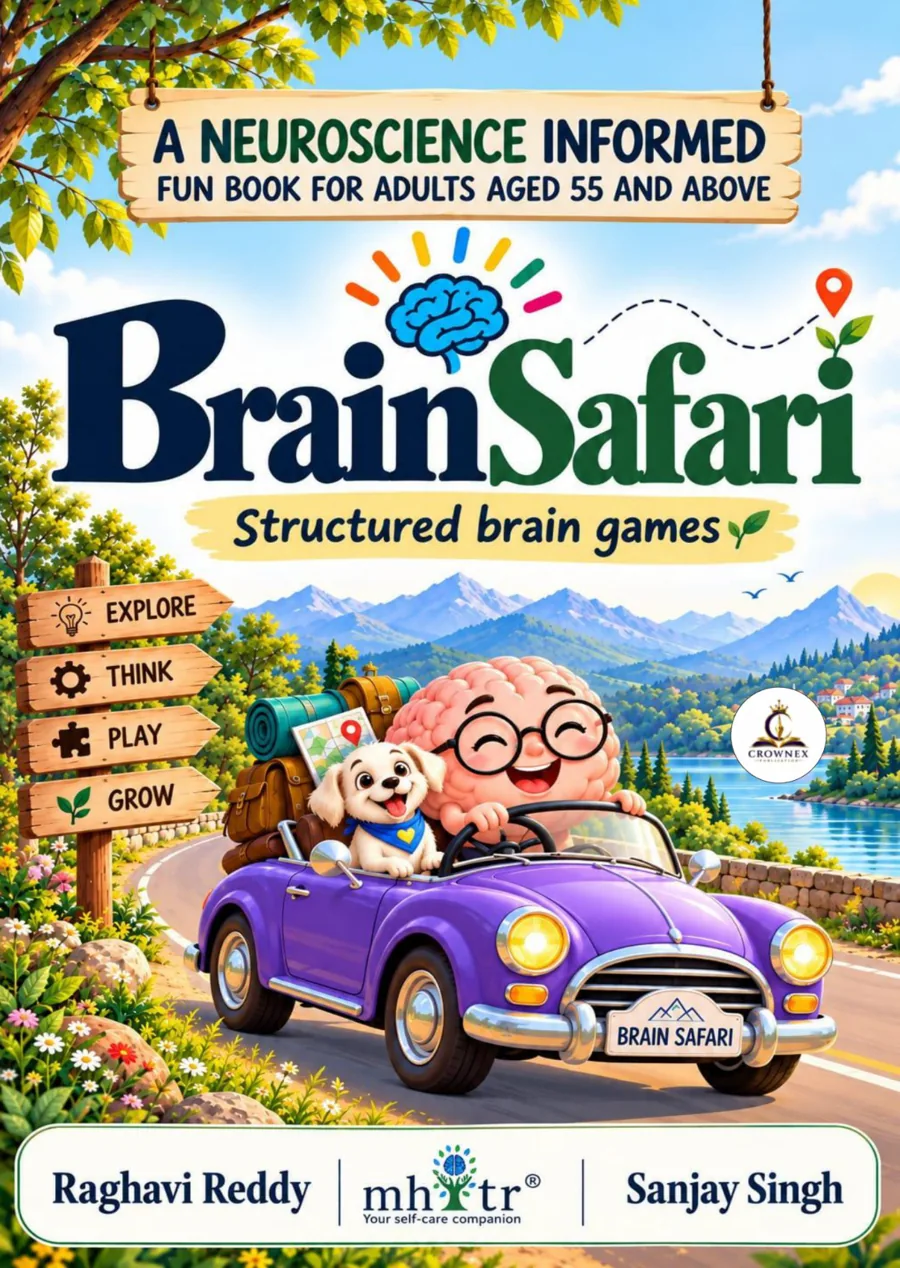
Brain Safari Book: 129 structured brain games for adults 55+
A neuroscience-informed book of 129 brain games, one per page, built from three years of MHITR’s Vayofit sessions with older adults. Start easy and build up at your own pace.
- 129 brain games
- 3 difficulty levels
- 10 thinking areas
- 5–12 minutes a game
- Answer key included
- Ages 55+
Brain Safari at a Glance
- What it is
- A full-colour activity book of 129 brain games and puzzles, one game per page, with a complete answer key at the back.
- Who it is for
- Adults aged 55 and above who want to keep their minds active at home, and the families, caregivers and facilitators who play alongside them.
- How it is organised
- Games are grouped into Level 1 (easy), Level 2 (moderate) and Level 3 (advanced), so everyone starts with success and builds up.
- What each page shows
- The thinking skill being trained, a small map of the brain areas involved, a suggested time, and space to note the date and your time taken.
- Where it comes from
- Every activity is drawn from MHITR’s Vayofit Online Program, refined over three years of game-based sessions with adults over 55.
- Publication details
- Published by Crownex Publication on 20 October 2026. ISBN 978-81-6611-041-2. Price ₹699.
Why Brain Games Matter After 55
Some abilities stay strong with age: vocabulary, general knowledge and life experience. Others slowly become less efficient, such as how quickly we take in information, holding several things in mind at once, staying focused amid distractions, and remembering new events. Many people notice this as taking longer to find a word or a name.
The good news is that the brain keeps building and strengthening connections throughout life in response to what we do. This is neuroplasticity. People who stay mentally, socially and physically active also build cognitive reserve, extra capacity that helps the brain cope with ageing before daily life is affected.
Around 45% of dementia cases are linked to factors we can change, including inactivity, hearing loss, depression, loneliness and too little mental stimulation (Livingston et al., 2024). Structured activity helps: in healthy older adults, brain training brought benefits still visible ten years later (Rebok et al., 2014).
Ten Areas of Thinking, One Book
Each thinking skill relies on different brain systems, and practising only one helps little with the others. So the games cover every main area of thinking.
22 games
Numbers & Orientation
Mental calculation, time, place and direction
Restaurant bills, bus timetables, calendars, sun and shadows
21 games
Memory
Short- and long-term memory, linking and recall
Story memory, faces and names, memory flashbacks
20 games
Attention & Concentration
Focusing, ignoring distractions, switching
Mazes, visual search, connect the trail, switch the rule
20 games
Language & Verbal Thinking
Finding words, understanding, explaining
Category sprints, word links, sayings, jumbled words
18 games
Logic & Reasoning
Logic, problem solving, spotting patterns
Logic grids, Tower of Hanoi, family tree, lock codes
11 games
Visual & Spatial
Seeing, turning and fitting shapes
Mirror and rotation games, cube folding, town maps
6 games
Planning & Problem Solving
Everyday judgement and planning ahead
Notice boards, phone messages, plan my morning
5 games
Fine Motor & Facial Skills
Hand control, coordination, eye and face movement
Finger gym, steady-hand tracing, clap and tap rhythms
4 games
Creativity
Imagination and flexible thinking
Clever uses, what if…?, invent something new
2 games
Perception & Illusions
Visual judgement and careful observation
Can you trust your eyes? Sizes, lengths and ghost shapes
Three Levels, at Your Own Pace
The brain changes most when a task is hard but achievable. Everyone starts with success in Level 1, then builds up.
Level 1: Easy
41 games · Games 1–41
Gentle warm-up games to build confidence and a daily routine.
Games include
- Heart-Shaped Maze
- Story Memory: The Temple Visit
- Name, Place, Animal, Thing
- Memory Lane
Level 2: Moderate
50 games · Games 42–91
Longer puzzles that mix memory, logic and everyday numbers.
Games include
- Faces and Names
- Check the Restaurant Bill
- Reading the Bus Timetable
- Who’s Who? The Hobby Club
Level 3: Advanced
38 games · Games 92–129
Stretching challenges in reasoning, planning and calculation.
Games include
- Tower of Hanoi
- Update the Passbook
- Which One Folds Into a Cube?
- Crack the Lock Code
Look Inside the Book
One game per page, printed in full colour with large, clear type. Every page shows:
- The cognitive area and the specific skills each game trains
- A brain map highlighting the regions the game engages
- A clear difficulty marker: Level 1, 2 or 3
- A suggested time, plus space to record your date and time taken
- Memory Flashback pages at the end of each level that recall earlier games
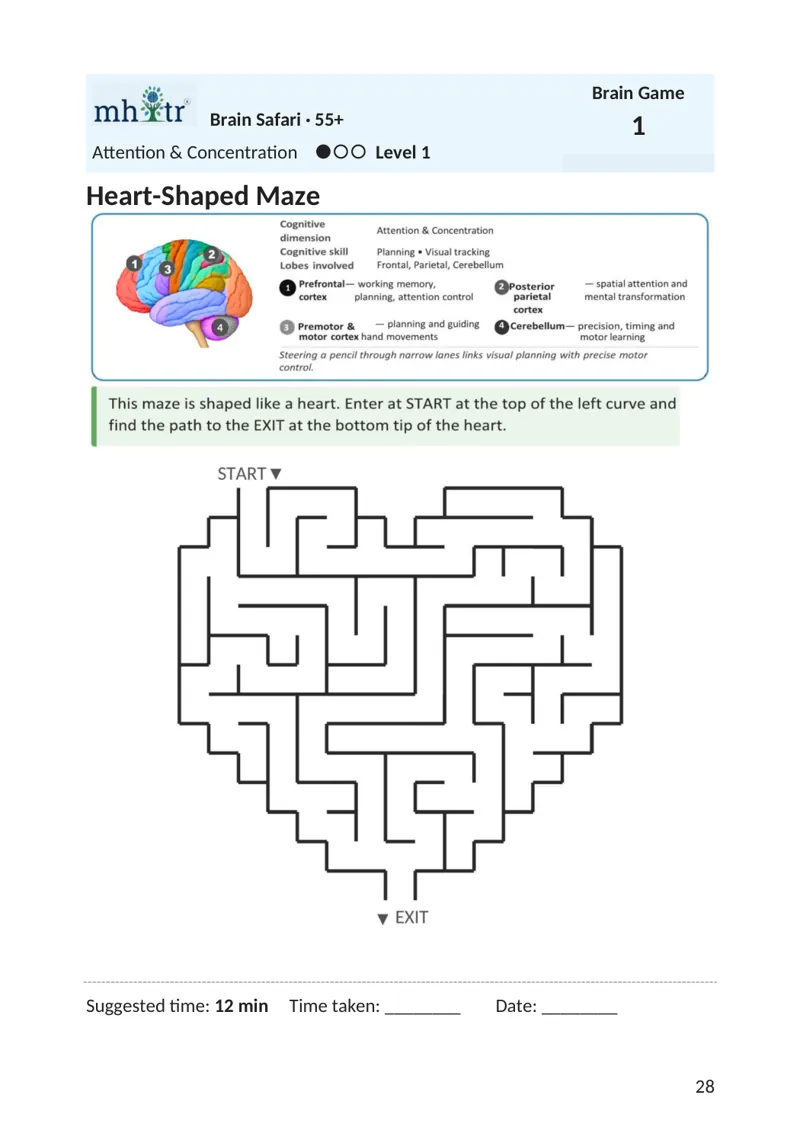
Game 1 · Heart-Shaped Maze · Attention & Concentration 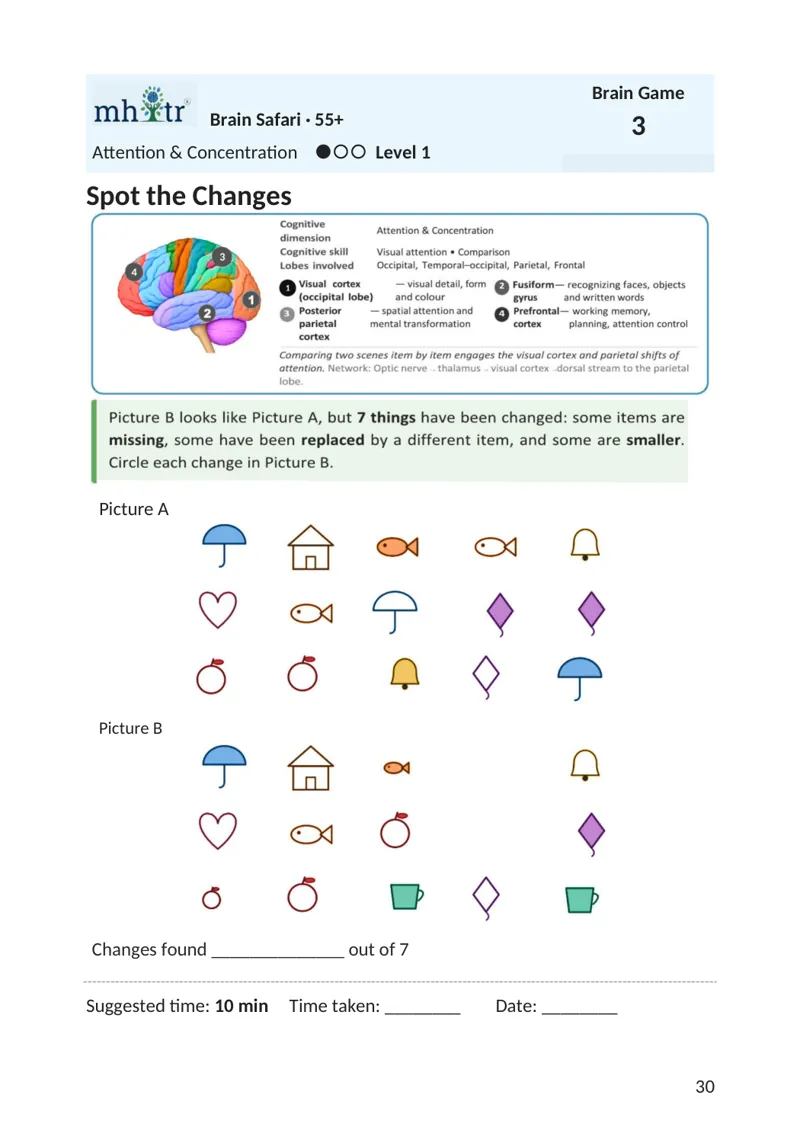
Game 3 · Spot the Changes · Attention & Concentration 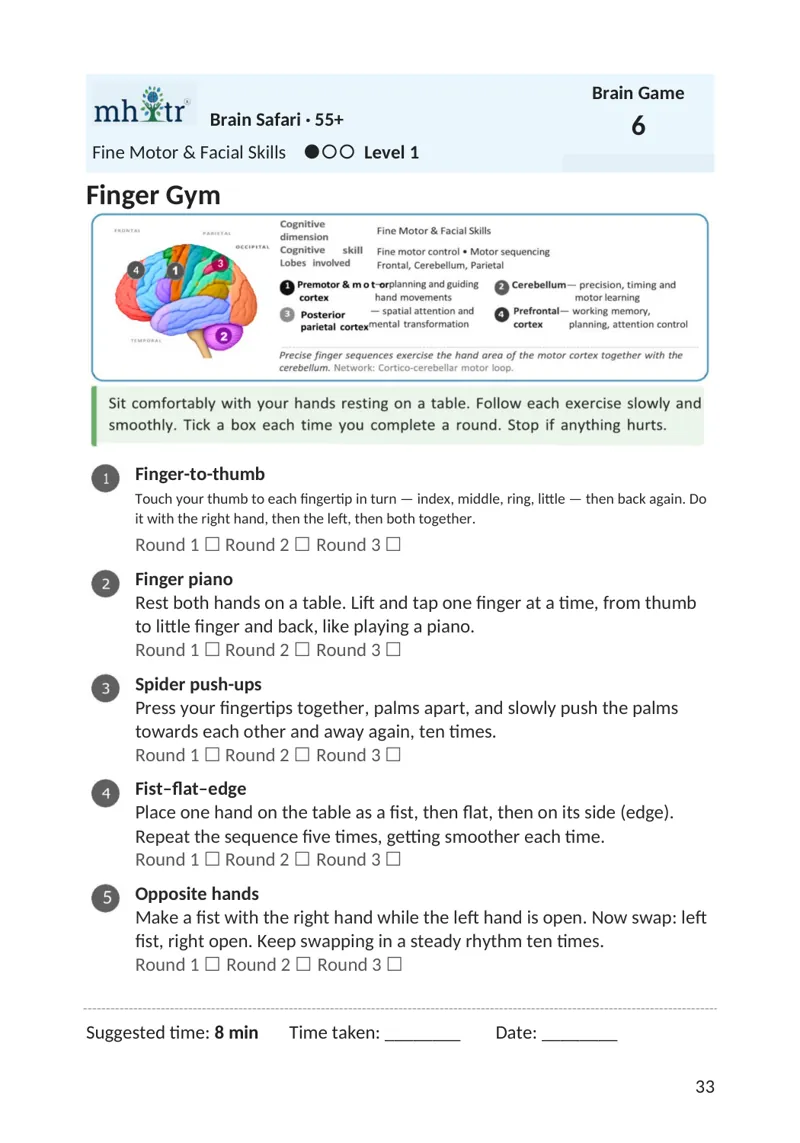
Game 6 · Finger Gym · Fine Motor & Facial Skills
How to Use Brain Safari
For the player
- Do one or two games a day. Little and often works best for the brain.
- Sit in good light, wear your reading glasses and use a pencil with an eraser.
- Start with Level 1, and move on to Levels 2 and 3 when you feel ready.
- Write the date and your time. Repeat a favourite game after a month and compare.
- Check your answers at the back only after you have tried your best.
For family and facilitators
- Praise effort, not only correct answers.
- Talk about the game afterwards. It adds language and memory practice.
- On Memory Flashback pages, do not let the player turn back.
- Hand, face and creative activities have no single right answer. Every honest attempt counts.
Built on Three Years of Vayofit Sessions
Brain Safari brings the activities of the Vayofit Online Program into the home. A one-year longitudinal study of the program (August 2023 to August 2024) followed 127 participants with a median age of 73, including people living with hypertension, diabetes, Parkinson’s disease and depression.
| Measure | Baseline | After 12 months |
|---|---|---|
| Range of cognitive scores | 60–94% | 66–96% |
| Median blood pressure | 136/88 mmHg | 128/80 mmHg |
| Lipid profile | 145 mg/dL | 133 mg/dL |
| Blood glucose | 187 mg/dL | 152 mg/dL |
These findings were presented as scientific abstracts at DemCon 2024 and GeriCon 2026. They describe outcomes of the Vayofit Online Program, not of the book on its own. As an observational study without randomisation, the results describe what participants experienced rather than proof of cause and effect.
Stories from Our Sessions
The book shares case studies from MHITR sessions. Every person is different, and progress depends on health, regularity and support.
“An older adult can pick it up during a quiet afternoon, while enjoying a cup of tea, or whenever a few moments of leisure are available… After all, ageing may be inevitable, but losing our curiosity need not be.”
Meet the Authors


Continue Your Journey with Vayofit
Brain Safari is one part of MHITR’s approach to healthy ageing: staying physically active, mentally engaged and connected.
For elders at home
Vayofit Online Program
Live 90-minute sessions led by a trained facilitator: strength and conditioning, cognitive stimulation, and mindfulness and yoga. Morning and evening batches.
Explore the programFor homes, care settings and clubs
Vayofit Wellness Kit
A touch-and-feel kit of screen-free brain activities, available as VWK Lite for homes and VWK Premium for hospitals and senior living communities.
See the kit
FAQ
Who is Brain Safari for?
Brain Safari is written for adults aged 55 and above who want to keep their minds active at home. Families, caregivers and facilitators can also use it to run shared brain-game sessions.
How difficult are the games?
The 129 games are arranged in three levels: 41 easy games in Level 1, 50 moderate games in Level 2 and 38 advanced games in Level 3. Start with Level 1 and move up when you feel ready.
How long does each game take?
Most games suggest between 5 and 12 minutes. The book recommends one or two games a day, because little and often works best for the brain.
Are the answers included?
Yes. A complete answer key sits at the back of the book. Try your best first, then check your answers.
How is Brain Safari related to the Vayofit Online Program?
Every activity in Brain Safari is drawn from the Vayofit Online Program, where MHITR® facilitators have run game-based sessions with adults over 55 for three years. The book lets you keep practising between sessions and beyond them.
Can Brain Safari prevent or treat dementia?
No. Brain Safari supports brain health and wellbeing through regular, structured mental activity, but it is not a diagnosis or a medical treatment. If memory or thinking changes worry you, please consult a doctor or clinical psychologist.
How do I order a copy?
Brain Safari is priced at ₹699. To order a copy, or to ask about bulk orders for senior living communities and clubs, contact us.
Ready when you are
Start your Brain Safari today
One or two games a day, a pencil and a cup of tea. That is all it takes to keep your mind curious, active and engaged.
- 129 brain games
- 3 difficulty levels
- 10 thinking areas
- 5–12 minutes a game