There is a quiet milestone in ageing that rarely gets celebrated. The day someone climbs the stairs without asking for help. The day getting out of a chair feels easy again. The confidence to walk around the neighbourhood, prepare a meal, tend to the garden, or simply move around the house safely can mean far more than we realise.
Healthy ageing is not about trying to turn back the clock. It is about preserving the things that allow a person to live with independence, dignity and confidence as the years pass — and sometimes, that begins with something as simple as movement.
When growing older starts changing the way we move
Balance training for the elderly and steady, gentle movement are the two things that decide how independently a person keeps living at home — which is why healthy aging and exercise are hard to separate.
Ageing does not look the same for everyone. Some people remain remarkably active well into later life, while others gradually experience changes in strength, balance, flexibility or coordination. The problem is not necessarily ageing itself; it is what can happen when reduced movement becomes a routine.
A person who finds walking difficult may begin walking less. Someone who feels unsteady may avoid the stairs. Someone worried about falling may stop going outside altogether. Slowly, a protective instinct can become a cycle:
Less movement → less confidence → less activity → greater loss of mobility.
The World Health Organization recommends regular physical activity for older adults, and specifically highlights activities that improve balance and help prevent falls for people with reduced mobility. It also advises that physical activity should be adapted to a person’s abilities and health conditions.
That last part matters. Healthy ageing does not ask every 70-year-old to exercise like a 25-year-old. Instead, it finds the right kind of movement for the person in front of you.
Where physiotherapy comes in
Physiotherapy plays an important role in helping older adults maintain or regain functional movement.
For a senior, progress is not running a marathon. It might mean standing from a chair more comfortably, improving balance while walking, managing stairs, recovering after an injury, or feeling confident enough to go outside again. This is why physiotherapy for elderly people at home in India can be particularly valuable. The home is where many of the challenges actually happen.
Can the person safely move from the bedroom to the bathroom?
Can they stand up from their usual chair?
Can they navigate the kitchen?
Can they manage the steps at the entrance?
Physiotherapy is not just abstract exercises; it becomes an anticipated part of everyday life. In practice, simple physiotherapy exercises for seniors at home — seated leg raises, supported standing drills, heel-to-toe balance walks along a hallway — are often what actually rebuild the confidence to do these things again, rather than any dramatic intervention.
A good programme therefore needs to consider the individual’s existing mobility, health conditions, strength and goals, rather than handing every senior the same exercise routine.
Research supports the importance of exercise that combines elements such as balance, functional movement and strength in reducing falls among older adults. A large systematic analysis involving more than 30,000 participants found that specific combinations of balance, stability and functional exercises were particularly useful for fall prevention.
For families searching for elderly care physiotherapy, this is an important distinction to keep in mind: the goal should not simply be exercise for exercise’s sake, but movement that helps an older person function more confidently in everyday life.
And then there is yoga
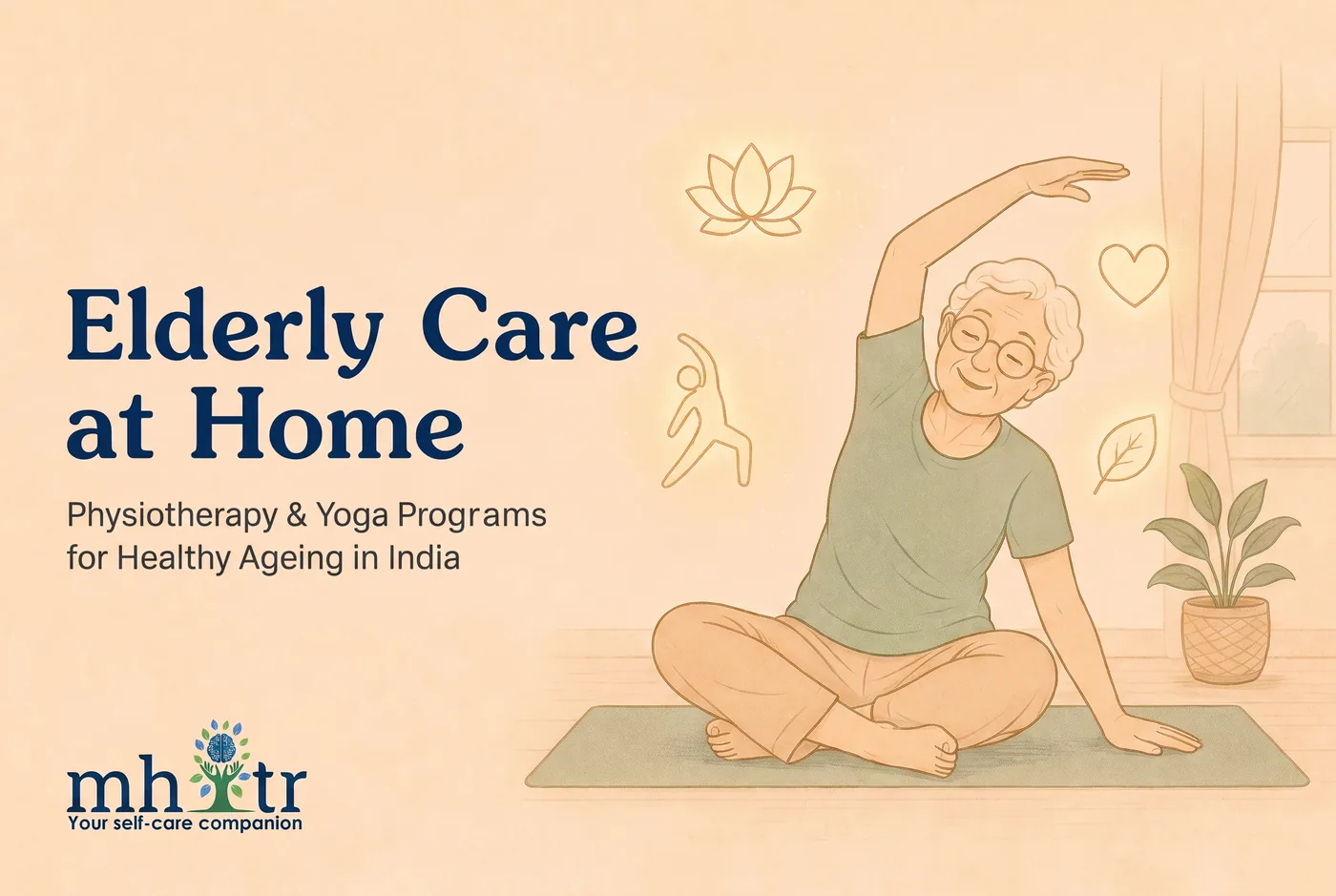
Yoga has been part of India’s cultural heritage for centuries, but its relevance to healthy ageing is not merely historical. Yoga for senior citizens is usually adapted rather than intense: seated or chair-supported postures, slower transitions, and breathing work.
In 2026, the World Health Organization highlighted “Yoga for Healthy Ageing” as the theme surrounding the International Day of Yoga, recognising the potential role of adapted yoga in supporting balance, flexibility, strength and mobility.
That adaptability is one of yoga’s strengths. For an elderly individual, we cannot expect complicated poses or folding oneself into a shape that belongs on Instagram. Rather, it involves gentle movements, breathing, balance work and mindfulness, adjusted to the individual’s abilities.
WHO notes that yoga can be adapted for people of different ages and abilities, including those with mobility limitations. This makes yoga for seniors a useful complement to a broader movement routine. It can support mobility and flexibility while also creating a slower, more mindful approach to movement. And perhaps that matters more than we sometimes realise.
An older person who becomes more comfortable with their own movement may also become more confident about using it.
Why home can be the right place to start
Senior citizen yoga at home, and a senior citizen exercise routine done in the living room, remove the biggest practical barrier of all. Receiving support in a familiar environment has a certain reassuring sense to it. For some older adults, travelling to a clinic or fitness centre may itself be difficult. Others may simply feel more comfortable beginning an exercise routine at home, surrounded by the things and people they know.
Home-based care also allows movement to be connected to real life. Instead of asking only, “Can you perform this exercise?”, we can ask:
What would you like to be able to do more comfortably?
Perhaps it is walking to the local shop.
Perhaps it is playing with grandchildren.
Perhaps it is getting around the house without relying on someone else.
Perhaps it is simply being able to say, “I can still do this myself.”
These goals are small only if we fail to understand what independence means to the person living them.
Beyond the body: memory, mood and keeping elderly parents mentally active
Movement does not exist in isolation. An older adult who becomes less mobile may also become less socially active. A person who stops going out may lose some of the routines and interactions that once gave structure to their day — and with them, some of the everyday mental stimulation that comes from conversation, planning and simply navigating the world.
This is one reason families often ask not just “how do we keep Mum or Dad moving” but “how do we keep them mentally active.” A few signs of cognitive decline in elderly parents are worth families paying attention to, without jumping to conclusions from any single instance:
Repeating the same question or story within a short span of time
Increasing difficulty following a conversation or a familiar recipe
Misplacing items in unusual places, or losing track of dates and routines that were once automatic
Withdrawing from conversations, hobbies or social plans they used to enjoy
Getting disoriented in familiar surroundings
None of these, on their own, confirm a diagnosis; many can also reflect stress, poor sleep, low mood or simply a distracting day. But a noticeable pattern — especially one that a family member points out because it feels different from “who they usually are” — is worth raising with a doctor rather than waiting.
On the more everyday side, keeping elderly parents mentally active does not require anything elaborate. Simple, consistent habits tend to matter more than occasional big efforts:
Regular conversation and storytelling — asking about their past, their opinions, their day
Familiar, mentally engaging activities: cards, puzzles, reading aloud, cooking together
Maintaining a predictable daily routine, which supports both memory and a sense of security
Staying socially connected — visits, calls, community activities — rather than isolated
Physical activity itself, which research increasingly links to cognitive as well as physical benefits
MHITR®’s own approach to senior wellness reflects this by combining physiotherapy and gentle yoga with cognitive and emotional components. Its Vayofit programme is designed for adults aged 55 and above and aims to support mobility, memory, orientation and emotional well-being from home. It is enough, for now, to remember that the body and the mind do not age in separate rooms.
What does a structured senior wellness programme look like?
The most difficult part of elderly care is not the “what” but the “how”. A family can easily understand that an ageing parent needs to stay active; the challenge is figuring out how to make that happen consistently.
A senior citizen wellness programme in India can provide structure where a family may otherwise struggle to create one. The important questions are whether the programme is appropriate for the person’s age and abilities, whether qualified professionals are involved, and whether the activities are practical enough to become part of everyday life.
Vayofit by MHITR® is one example. Designed for adults aged 55+, it combines guided physiotherapy and yoga with other wellness activities in an online, home-based format. Sessions are led by professionals including physiotherapists, psychologists and mindfulness instructors, structured around movement, balance, strength, memory and confidence.
The programme currently offers multiple batches and time slots, with recorded sessions available when participants miss a live session. Batches are limited to 20 participants to allow for more individual attention.
That structure can be useful for families who want something more consistent than occasionally reminding a parent, “You should exercise more.”
Explore Vayofit for seniors 55+
A better way to think about ageing
Perhaps the biggest mistake we make is treating ageing as a process of gradually losing things — less strength, less movement, less independence.
But healthy ageing gives us another way to look at it. What if the goal is not to prevent every change that comes with age, but to help people retain as much function, memory, confidence and independence as possible?
India’s National Programme for Health Care of the Elderly (NPHCE) similarly places active and healthy ageing within a broader approach that includes preventive, curative and rehabilitative care for older adults.
Physiotherapy can help preserve functional movement. Yoga can offer an adaptable way to work on balance, flexibility, strength and mindful movement. Together, when appropriately prescribed and delivered, they can become part of a healthy ageing programme in India that treats movement not as a punishment or a medical chore, but as a way of remaining engaged with life.
A small start is a meaningful start
For families caring for older parents, the first step is not a big gesture but rather the small things of daily life. A few things you can start with:
Arranging a professional assessment.
Encouraging a daily walk appropriate to the person’s abilities.
Exploring gentle yoga, or a few physiotherapy exercises for seniors at home.
It might simply be asking:
What would you like to be able to do more easily?
That question changes the conversation. Instead of seeing an older parent only in terms of what they can no longer do, we begin thinking about what can still be strengthened, supported and enjoyed.
Because healthy ageing is not about making someone young again. It is about helping them keep living fully in the age they are. And sometimes, the road to greater independence begins with one careful step.
References
Government of India, Directorate General of Health Services. (n.d.). National Programme for Health Care of the Elderly (NPHCE). NPHCE official programme page
Sibley, K. M., et al. (2021). Comparative effectiveness of exercise interventions for preventing falls in older adults: A secondary analysis of a systematic review with network meta-analysis. Experimental Gerontology, 143, 111151. PubMed record
World Health Organization. (2022). Being active in later adulthood. WHO guidance
World Health Organization. (2026, June 26). Yoga for healthy ageing: Global practice and clinical evidence. WHO article
World Health Organization. (2026, June 20). International Day of Yoga 2026. WHO South-East Asia statement
MHITR®. (n.d.). Vayofit. MHITR® Vayofit programme
MHITR®. (n.d.). Healthy ageing for seniors. MHITR® healthy ageing resources