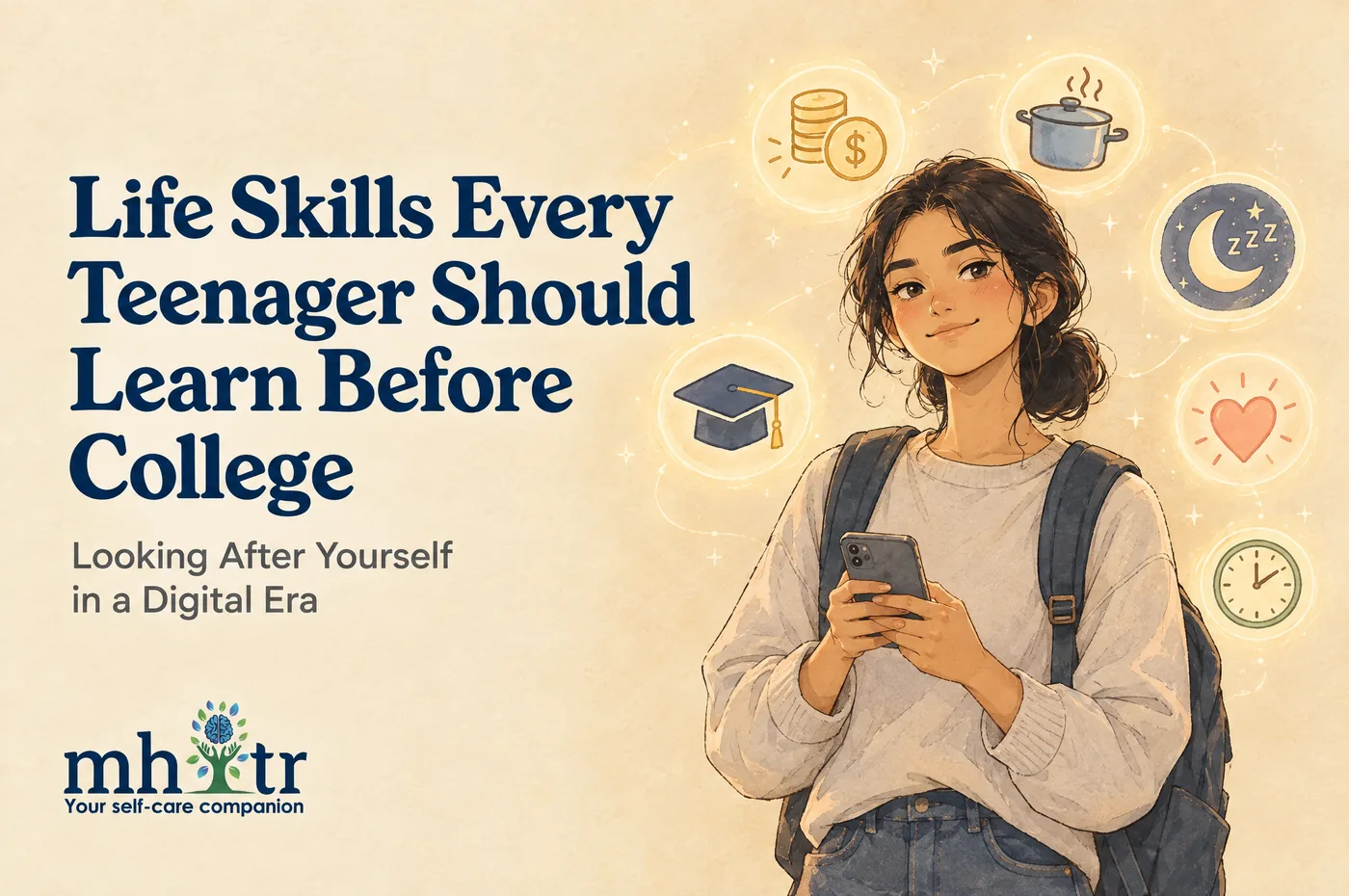
It is said that the only constant in life is change itself, and as such the world as we know it is not the same as it was five to ten years ago. We are always asked to adapt to change, and perhaps that is something we must explore in regards to how we live life.
We live in a digital era, where everything is just a tap away, be it food, entertainment, work and especially school/college, the list goes on and on. Needless to say, things have gotten a lot easier. But not all of the digital era is here to make things easy or to protect you; we have seen many instances of people either using technology for bad causes or being harmed by the same digital era.
When things go wrong, we look back to the very life skills that our parents grew up with, in a desperate attempt to reverse or fix things. But we forget that when those skills were coined, the world was not where it is today. Perhaps that is exactly what we are trying to solve here; a set of skills that is ready to navigate the modern age.
The not so easy part of the digital era
For all its convenience, the digital era did not arrive with an instruction manual for how to actually live inside it. Nobody sat previous generations down and taught them how to manage a mind that is reachable at every hour, expected to respond instantly, and constantly fed more information than it can reasonably process. A student navigating it is, in a very real sense, managing something that did not exist when the adults around them were figuring out how to grow up.
The issues of the digital era go beyond too much screen time, though that is part of it. It is that the digital world was not built to pause for a teenager to catch up. It moves at its own pace, and it was largely designed to hold attention rather than protect wellbeing.
The result shows up in ordinary, everyday ways. Sleep deprivation, record low attention spans, and a phone full of contacts that somehow still feels lonely. The pressure of being available, informed and “on” all the time has a name, even if students won’t use it for themselves.
That name is stress, and it may be the most important part to analyse, because it tends to be the first sign that the digital era is asking more of a young person than they are currently equipped to manage.
Recognising stress before it takes over
Stress itself isn’t necessarily a bad thing, matter of fact, a deadline can motivate someone to work harder. An upcoming exam can encourage preparation. A new responsibility can push a student to grow. The problem starts when stress becomes hard to manage or starts interfering with everyday life.
A student who’s constantly exhausted, unable to concentrate, increasingly irritable, withdrawing from friends or struggling to maintain ordinary routines may need more support than simply being told to “work harder” or “calm down.”
A simple exercise helps here: instead of just thinking I’m stressed, ask what’s actually causing the pressure, what part of it can be controlled, what needs to happen now versus what can wait, what usually helps recovery, and who to talk to if it becomes too much to handle alone. These questions turn a vague, uncomfortable feeling into something a student can actually examine and act on.
WHO identifies managing emotions, developing coping and problem-solving skills, healthy sleep patterns and regular physical activity as key parts of adolescent wellbeing — alongside supportive environments at home, school and in the wider community.
The physical habits behind mental wellbeing
It is a common paradigm to treat physical health and mental wellbeing as two completely different entities when what actually helps is the balance of all. Sleep, movement, food, rest and social connection all shape how a young person feels and functions. A student who’s regularly up until 2 a.m., studying, scrolling, or both, is eventually going to feel the consequences somewhere.
There’s no rigid checklist here, just ordinary habits that make a difference: a reasonably consistent sleep routine, regular physical activity, balanced meals instead of relying entirely on convenience food, real breaks during long study sessions, some time outdoors, and relationships that don’t live entirely on a screen. None of this is glamorous, and that’s kind of the point. Looking after yourself is usually less about one perfect wellness trick and more about keeping basic habits consistent.
UNICEF India similarly points to movement, outdoor activity and healthy routines as part of supporting children and adolescents’ physical and emotional wellbeing.
Building a healthier relationship with your phone
One item that has become the pinnacle of what is the digital era is the smartphone. Every tool you could possibly need, all wrapped in a hyper-efficient rectangle that doubles as a fashion accessory and you can carry with you everywhere; it doesn’t get better than that surely.
Smartphones aren’t inherently bad; I, for one, am certainly grateful for not having to carry around a dictionary or landline everywhere. Students use smartphones to study, communicate, create, navigate, access information and maintain relationships. The more useful question isn’t whether technology is good or bad; it’s who’s actually deciding how it gets used.
A student might pick up their phone to answer one message and still be scrolling forty minutes later. Another might open a laptop for an assignment and drift between study material, social media and entertainment until the evening’s gone. Digital balance means being able to notice when technology is helping and when it’s starting to get in the way.
A few practical habits go a long way: keeping the phone away during focused study, turning off unnecessary notifications, building screen-free periods around meals or bedtime, separating academic screen use from recreational use, taking deliberate breaks instead of waiting until burnout, and occasionally checking whether online activity is actually improving the day or just filling every empty moment.
WHO notes that digital environments create real opportunities for learning, connection and access to services, while also creating risks such as excessive use, cyberbullying, harmful content and isolation. The relationship between tech use and wellbeing is complicated, which is exactly why the goal is healthier digital behaviour, not treating all screen use as the enemy.
Naming emotions instead of reacting to them
Emotional regulation is not about being calm all the time. Teenagers are going to feel angry, disappointed, embarrassed, jealous, anxious and frustrated. The skill here, is knowing what to do with those emotions once they show up.
A student with a poor exam result might immediately think I’m not good enough. Someone excluded from a social event might decide nobody likes me. Someone criticised by a teacher might react with anger before even considering what actually happened. Emotional regulation creates a small but important gap between feeling something and acting on it: naming the emotion, pausing, identifying what triggered it, and choosing a response instead of reacting automatically.
It isn’t about suppressing emotions at all; quite the opposite. A student who can recognise what they’re feeling is in a much better position to actually communicate it.
Making room for relationships outside the screen
Humans are social creatures, and as much as we have tried to believe that we are connected on a digital interface, nothing beats the value of a live conversation. A phone can connect a student to hundreds of people while still leaving them feeling alone. Social media helps maintain friendships and build communities, but scrolling through someone’s day doesn’t provide the same quality of connection as spending real time with them — talking face-to-face, sharing an activity, simply being around others.
That might mean eating lunch with classmates instead of scrolling through the meal, joining a sports team or club, calling a friend instead of sending another reaction emoji, or just making time for family. UNICEF highlights the role of positive relationships with caregivers, open communication and real opportunities for young people to talk through school, friendships, worries and feelings.
What digital balance actually looks like
Forget chasing some magic number of screen-free hours. What actually matters is getting back the ability to decide when to use technology and when not to; a decision that gets harder to make well as students move into environments with fewer adults monitoring their routines.
If a student’s online during every free moment, one screen-free hour each evening is a reasonable place to start. If social media is wrecking sleep, cutting it out of bed is the fix. If notifications keep breaking concentration, switching them off during focused work solves it directly. Small, specific changes, not a dramatic phone-in-a-lake gesture.
How these skills actually get practised
Students rarely develop any of this just because someone tells them it’s important. They need opportunities to actually practise it. A classroom scenario asking how they’d respond to a stressful situation, a simple mood journal kept for a week to spot patterns, a group discussion on how social media affects friendships, a student designing and testing their own realistic study-and-rest routine.
Life-skills education means helping adolescents build constructive ways of responding to problems, make healthier choices, resist negative pressure and build resilience — recommending participatory approaches like role-play, group exercises, creative projects and brainstorming over straight instruction. Programmes like Igniting Minds, by MHITR®, built around student life skills and emotional wellness such as: emotional regulation, stress management, self-awareness, self-discipline, communication, empathy, problem-solving, decision-making, resilience, healthy lifestyle choices and digital balance are a perfect fit, precisely because these skills need somewhere structured to actually get practised, not just discussed.
A role to play
Young people don’t learn wellbeing skills in isolation. Adults help most by modelling the behaviour they expect. A parent telling a teenager to put their phone away while checking their own throughout dinner sends a mixed message, and so does a teacher who talks about stress while treating every mistake like a crisis.
Students need realistic expectations, real chances to make age-appropriate decisions, and adults they can approach without immediately expecting judgement. And when a student is experiencing persistent or serious distress, life-skills education isn’t a substitute for professional support. Counselling and other appropriate services still matter when a young person genuinely needs them.
Making the jump into the open world
College doesn’t make anyone independent overnight. It just strips away some of the structures that made independence easier to fake. Nobody’s reminding you to sleep. Nobody’s noticing six hours lost to scrolling. Nobody’s organising your assignments or telling you that you’ve been carrying stress for too long.
That’s why the skills covered across this series matter before that transition, not after it. Can you manage yourself? Can you manage your thinking? Can you live and work with people who aren’t exactly like you? And can you look after yourself when nobody else is organising your life for you?
None of this is a subject to pass. These four areas overlap constantly rather than operating as separate abilities. Poor organisation increases stress, stress makes communication harder, and a bad night’s sleep makes everything else on this list more difficult. They’re the practical tools that help a student actually use what they’ve learned, handle what life throws at them, and gradually become capable of running their own life. And perhaps that is a little more assuring for the parents and a lot more satisfying for the students.
References
- World Health Organization. (2025). Mental health of adolescents. WHO
- World Health Organization. (n.d.). Promoting adolescent well-being. WHO
- World Health Organization. (n.d.). Digital environments and mental health. WHO
- United Nations Children’s Fund. (2025). Guide: Adolescents and life skills education. UNICEF
- United Nations Children’s Fund India. (2022). Tips for parents and caregivers to support adolescents. UNICEF India
- United Nations Children’s Fund India. (2025). Beyond screens: Move more, live better. UNICEF India
- United Nations Children’s Fund India. (n.d.). Mental health and well-being. UNICEF India