We all remember that sound, that atmosphere that loomed over the home during exam season. The unmistakable aroma of brewing ginger-elaichi chai and the eerie silence, interrupted by the occasional flipping of pages. And, somewhere in the background, a parent asking: “How much have you studied?”
It is often presented as an innocent question, sometimes repeated five times before dinner, but then comes the comparison.
“Your cousin has already finished the syllabus.” “You need to get serious now.” “What are you going to do if you don’t get into a good college?”
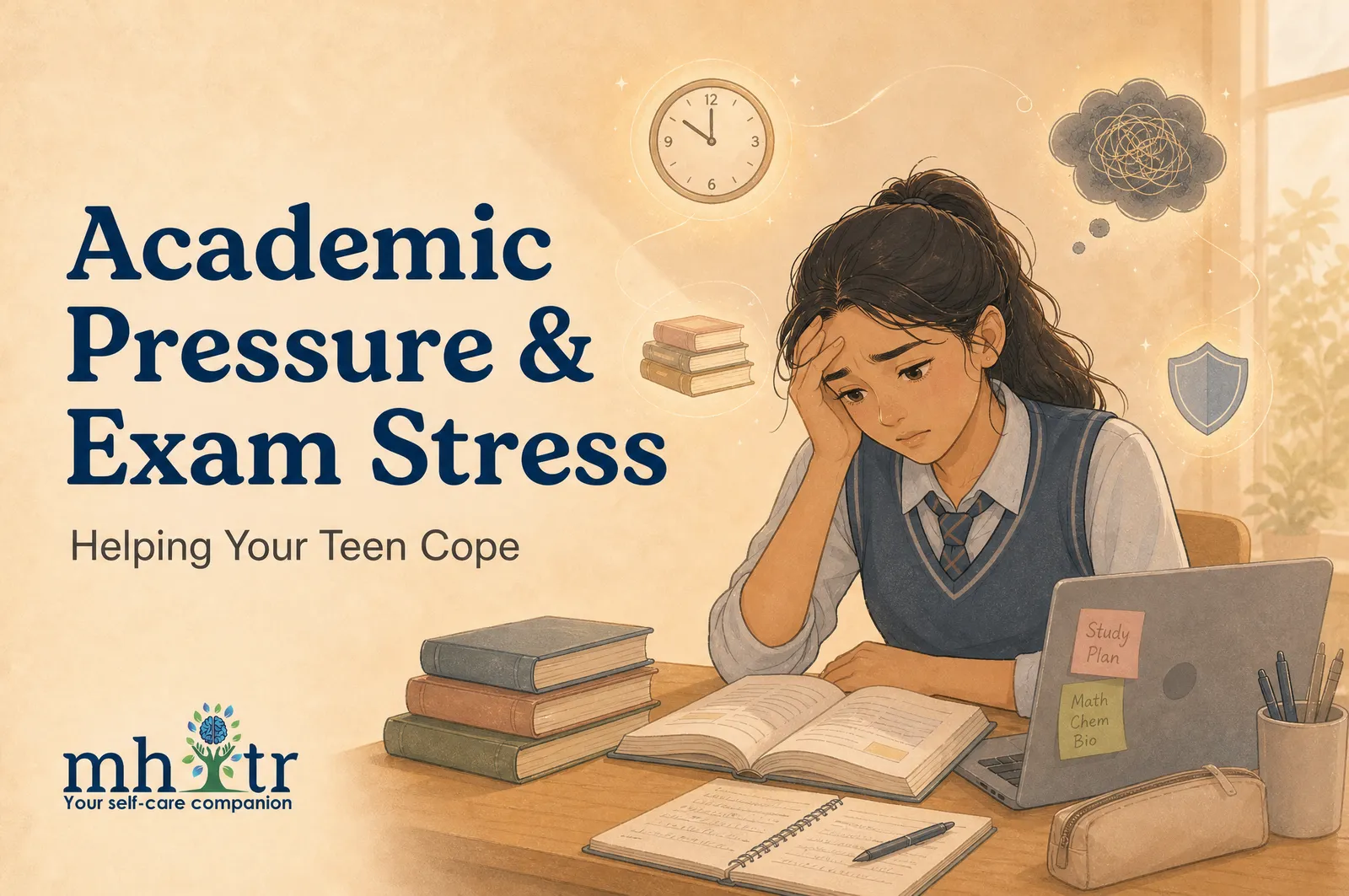
From a teenager’s perspective, exams are not simply exams; they can feel like a verdict on intelligence, discipline, family expectations and even the future they are meant to build.
That is why academic pressure, student stress management and teen mental health in India deserve a more thoughtful conversation. Exams are undoubtedly very important and could shape the options in front of a young person. The idea remains to help the student understand that an exam matters without becoming the measure of their entire self-worth.
What is exam pressure?
Exam pressure is the stress a student feels when the expectations around an examination, their own or other people’s, begin to outweigh their sense that they can meet them. It goes by several names: academic pressure, study pressure, school pressure or academic stress. A manageable amount is normal and even useful. It becomes a problem when it starts to affect sleep, mood, health or the ability to think clearly.
When does healthy academic pressure become too much?
Some pressure is normal. A little nervousness before an examination can sharpen attention, and a deadline encourages a student to stop procrastinating. In simple terms, wanting to perform well can motivate someone to put in the work.
How much stress is normal before exams? Enough to create focus, but not so much that it begins to damage sleep, appetite, mood or the ability to think clearly. The problem begins when pressure stops being motivating and starts becoming intimidation.
Research examining academic stress in students approaching high-stakes examinations has found links between academic distress, anxiety, perfectionism, sleep problems, coping difficulties, self-efficacy and social support. A systematic review of 60 studies found that approximately one in six students experienced excessive distress, although estimates varied across studies and countries.
A larger systematic review published in 2023 also found that most of the studies it examined reported a positive association between academic pressure and at least one mental-health outcome, including anxiety and depressive symptoms. The authors were careful to note that much of the available evidence cannot establish causation on its own.
So perhaps the question is not “Is my child stressed?” They probably are. A better question could be: “Is this stress still helping them function, or is it beginning to interfere with their life?”
Why teenagers experience academic pressure
This question is rather difficult, depending on who you ask.
India has a highly competitive education environment, particularly around board examinations and entrance tests. For some students, marks feel closely connected to access to particular colleges, courses or career paths.
Then there is the social layer. A teenager will be comparing their marks with classmates. Parents will be comparing them with relatives. Relatives ask questions at family gatherings. Coaching centres may be talking about rankings. Social media adds another window through which students can watch other people seemingly succeeding all the time.
In the middle of all this sits a student who just wants to make it in life, yet cannot tell whether a 78% score is actually a decent score or a catastrophe.
These pressures can interact. A 2025 Indian study involving 570 adolescents preparing for competitive entrance examinations found high reported levels of academic stress and perceived parental pressure, alongside substantial levels of anxiety and lower reported well-being. The study was conducted in pre-university colleges in Karnataka, so its findings should not be treated as representative of every Indian teenager, but they illustrate how closely academic expectations, examination anxiety and well-being can become intertwined.
Board exam anxiety is real
For a teenager sitting a board examination, the paper represents something larger than the paper itself. It carries months or years of preparation. It may feel connected to college admissions, and to career plans. And because everyone seems to be talking about the examination, it can become difficult to switch off.
Board exam anxiety in India is a lived experience for large numbers of students every year. Research on test anxiety has consistently found relationships between high test anxiety and poorer educational outcomes, although the strength of these relationships varies, and anxiety does not determine an individual’s ability or future.
Signs of exam stress in teenagers
When your child is stressed, they will rarely come out and say “I am stressed.” Teenagers can be very good at hiding what they are carrying. Nonetheless, there are usually signs:
- Constantly feeling exhausted
- Difficulty sleeping, or sleeping excessively
- Irritability or sudden mood changes
- Withdrawing from family or friends
- Losing interest in things they normally enjoy
- Difficulty concentrating
- Persistent headaches or stomach discomfort
- Repeatedly saying they are incapable of succeeding
- Avoiding study because the thought of it feels overwhelming
- Studying for long periods while becoming less productive
One bad day does not automatically mean burnout. Teenagers can be moody, tired and overwhelmed without having a mental-health condition. What matters is persistence, severity, and change from their usual behaviour.
Emotional effects of study pressure
Sustained study pressure rarely stays inside the timetable. It shows up in how a teenager feels about themselves: fear of failure, shame after a poor mark, irritability at home, and a growing belief that their worth depends on their results. The research described above links academic pressure with anxiety and low mood, and the way adults respond to a disappointing result can either ease that or deepen it.
An exam is important. But is it an identity?
This might be the message your child is waiting to hear from you. It is possible to care deeply about your child’s results without making their results the centre of the relationship.
Consider two scenarios.
A 17-year-old girl is studying for her NEET exams and her mother says, “Let’s figure out how you can prepare better.” Her older brother asks, “What subject are you struggling with?” She takes a mock test and her scores are substandard. Her father says, “This result isn’t what we hoped for. Let’s work out what happened and put in more effort for the official exam.”
An 18-year-old boy is studying for the JEE exams. His parents say, “You are not working hard enough.” The neighbours say, “Why can’t you be like your brother?” He yields to the pressure and is unsuccessful in the exam. The relatives say, “You have ruined your future.”
The first scenario leaves room for a solution. The second leaves a teenager alone with shame.
How parents can help
You do not have to be a teacher or an academic expert to help your child. Most teenage stress management at home is ordinary: sometimes the most useful thing a parent can do is make the environment around studying a little less frightening.
- Ask what they need. Instead of immediately offering a solution, ask: “Do you want help with anything?” Sometimes the answer will be surprisingly simple.
- Break the mountain into smaller hills. “Finish chemistry” sounds enormous; “Let’s do two chapters today” is something the brain can actually work with. A realistic study plan makes a difference.
- Protect sleep. There is no work-around for exhaustion. Sleep supports attention, learning, memory and emotional regulation. A student staying awake until three in the morning every night may be accumulating study hours while losing some of the cognitive resources needed to use them effectively.
- Keep meals and movement normal. Eat, drink water, take breaks, move, talk to people. Then return to the books.
- Don’t turn every conversation into an academic progress report. Sometimes teenagers need to talk about a film, a friend, football, music or absolutely nothing related to their syllabus. Let them. They are still people outside the examination hall.
Healthy study habits
Good habits lower pressure because they replace a vague sense of “I should be studying” with a plan that has an end point.
- Plan the week, not just the day. A realistic timetable with breaks and one lighter day is easier to keep than a perfect one that collapses by Wednesday.
- Study in focused blocks. A defined stretch of work followed by a short break usually achieves more than hours of half-attention.
- Test, don’t just re-read. Past papers and self-quizzing show a student what they actually know.
- Spread revision out. Returning to a topic over several days works better than one long night before the paper.
- Keep one thing that is not academic. Sport, music or time with friends is recovery, not time lost.
We look at study methods in more detail in exam stress in teenagers: study methods and coping strategies.
This is why exam stress management for students should not begin the night before the examination. It begins much earlier, by building habits that make examination periods less overwhelming: the study techniques, the day-to-day pressure valves, and knowing when it is time to step in.
Sleep, screen time and exam stress
Sleep is usually the first thing sacrificed in exam season, and the most costly. Teenagers need 8 to 10 hours of sleep a night, and a tired brain learns and remembers less well. Late-night revision on a phone or laptop cuts into sleep twice: it pushes bedtime later and keeps the mind alert once the lights are off.
- Agree a fixed time when studying stops for the night.
- Keep screens off for the last hour before bed.
- Charge the phone outside the bedroom.
- Separate study apps from social media, so a “quick check” does not become forty minutes.
Our guide to healthy screen time for teenagers covers age-wise limits and how to set them without a nightly argument.
When counselling or professional support may help
If a young person appears to be struggling significantly — particularly if there are signs of depression, severe anxiety, self-harm or suicidal thoughts — this is no longer simply an exam-management problem. A qualified mental-health professional should be involved promptly.
Counselling can also help well before a crisis. A school counsellor or psychologist can teach a student practical ways to manage worry, perfectionism and exam panic, and can help parents work out how to support without adding pressure.
The World Health Organization emphasises that adolescence is a formative period for developing emotional and social skills, and that supportive environments at home, at school and in the wider community are important protective factors for adolescent mental health.
How Igniting Minds supports students
Much of what protects a teenager under exam pressure is skill rather than luck: noticing stress early, regulating emotions, managing time and asking for help. These skills can be taught. Igniting Minds is MHITR®’s mental wellness program for students aged 12 to 24, delivered in person on school and college campuses. Facilitator-led sessions cover emotional regulation, confidence, problem-solving, communication and digital balance, with home practice so that parents are part of the process. It is offered through institutions, so parents who would like it for their child can ask their school to get in touch. The same skills carry well beyond the exam hall, as we explain in self-management skills teenagers should learn before college.
The result is not the whole story
Eventually, the examination will end. The answer sheets will be submitted. The results will arrive. Some students will celebrate; some will be disappointed. Some will discover that the path they imagined is no longer available, and others will discover that a different path was waiting for them all along.
Years later, most people remember surprisingly little about the exact questions on a particular examination. They may remember who sat beside them. Who encouraged them. Who stayed awake while they studied. Who brought them tea. Who told them not to panic. Who reminded them that one difficult season did not define them.
That is what parents can give their teenagers during exam season. Not freedom from every pressure, and certainly not a guarantee of success. Something more useful: a safe place to land while they learn how to fly on their own.
Frequently asked questions
What is exam pressure?
Exam pressure is the stress students feel when the expectations around an exam seem greater than their ability to meet them. It is also called academic pressure, study pressure or academic stress. A little is normal; too much affects sleep, mood and concentration.
What are the signs of exam stress in teenagers?
Constant tiredness, trouble sleeping, irritability, withdrawing from family and friends, headaches or stomach aches, loss of interest in things they enjoy, difficulty concentrating and saying they cannot succeed. A pattern that lasts matters more than one bad day.
How can parents help a teenager cope with exam pressure?
Ask what they need before offering solutions, help break the syllabus into small daily goals, protect sleep and meals, avoid comparisons with other children and keep some conversations completely free of marks and revision.
How much stress is normal before exams?
Enough to sharpen focus and motivate revision. It is no longer healthy when it disrupts sleep or appetite, causes frequent physical complaints, or leaves a teenager unable to think clearly or wanting to avoid studying altogether.
How can teenagers manage academic stress themselves?
By planning revision in realistic blocks with breaks, testing themselves rather than only re-reading, sleeping 8 to 10 hours, keeping screens out of the last hour before bed, staying active and telling a trusted adult when it feels too much.
When should a teenager see a counsellor for exam stress?
When stress persists for weeks, interferes with daily life, or comes with signs of depression, severe anxiety or panic. Any mention of self-harm or suicidal thoughts needs prompt help from a qualified mental-health professional.
References
- Cassady, J. C., Tan, S. H., Robiullah, A., Badzovski, I., & Janiuk, J. (2025). Methods employed in studies identifying “levels” of test anxiety in university students: A systematic review. Behavioural Sciences, 15(3), 331. PubMed record
- Pal, A., et al. (2022). Prevalence of anxiety disorder in adolescents in India: A systematic review and meta-analysis. Cureus, 14(8), e28084. PubMed record
- Reshu, Kumar, S., & Rathi, A. (2025). Adolescent academic stress and exam anxiety in schools in the wake of the COVID-19 pandemic. Acta Psychologica, 261, 105820. PubMed record
- Steare, T., Gutiérrez Muñoz, C., Sullivan, A., & Lewis, G. (2023). The association between academic pressure and adolescent mental health problems: A systematic review. Journal of Affective Disorders, 339, 302–317. PubMed record
- von der Embse, N., Jester, D., Roy, D., & Post, J. (2018). Test anxiety effects, predictors, and correlates: A 30-year meta-analytic review. Journal of Affective Disorders, 227, 483–493. PubMed record
- World Health Organization. (2025). Mental health of adolescents. WHO fact sheet
- Paruthi, S., Brooks, L. J., D’Ambrosio, C., et al. (2016). Recommended amount of sleep for pediatric populations: A consensus statement of the American Academy of Sleep Medicine. Journal of Clinical Sleep Medicine, 12(6), 785–786. PubMed record