A while ago, I visited my grandmother at her Townhouse. She lives alone and it’s not everyday she gets a visit like that. I spent most of the day thinking of how she manages to live alone without feeling lonely. Then it clicked in my head that maybe I’m looking at this all wrong. I saw her receive a call from my aunt who lives miles away. I remembered about her community women’s group. I recalled how active she is on the family group chat.
Loneliness is described differently, depending on who you ask. Whereas others may see it as being alone; an empty house, a quiet afternoon, a phone that has not rung all day, sometimes loneliness looks like sitting at a family dinner while everyone else is busy with their own conversations. It can look like having children who call regularly but never really have time to talk.
Being alone and feeling lonely are not the same experience, even though we use the words as if they were interchangeable. And for elderly loneliness, that difference right there is the whole story.
How loneliness shows up
It’s yet to be understood exactly what constitutes loneliness and how does one get to that point. Broadly, it tends to arrive down one of two roads: the ordinary changes that come with a life reshaping itself, and the newer, modernised distance that has opened up between generations from growing up in entirely different worlds.
When the house empties
Children grow up. They study, they marry, they take jobs in cities that are sometimes a train ride away and sometimes an ocean away. All of this is exactly as it should be in life and none of it makes the house any less quiet once they’ve gone.
The first and most obvious shift is simply the absence: fewer footsteps, fewer voices, fewer reasons to cook for more than one or two. That alone fits the textbook perception of loneliness, even in a home that is otherwise comfortable and secure.
Stillmore, within this there is another factor; something not everyone can notice. In the period leading up to this change, we experience what can be called anticipatory dread, felt while everyone is still very much present. The realisation that eventually those children you have lived in the same house with for years are going to move out and live their own lives. It’s like that feeling you get just before a vacation ends or before school opens, and we all know how it ruins the whole experience. It sounds like trivial drama, but it’s a genuine, well-documented psychological experience.
The fear of being found out
What if the withdrawal isn’t out of dread or discrimination? There is another kind of withdrawal that has everything to do with staying quiet on purpose.
It is only fair to assume that an ageing person will notice that they are ageing. That awareness brings up a specific kind of social anxiety: the fear of being judged, misunderstood, or quietly written off as “not what they used to be.” Rather than risk that moment, it can feel safer to simply not go. Skip the gathering. Let the phone ring out. Decline the invitation before anyone has the chance to notice anything is different.
It is not their fault but simply a protective instinct. It is also one of the most effective, self-sustaining ways loneliness digs in.
The inevitable gap
In the modern age we live in, a new road has quietly emerged. The one shaped less by family and more by time itself. It begs the question, “have we forgotten how to communicate”.
Boomers, Millennials, Gen Z, Gen Alpha: each generation didn’t just grow up with different music or different slang, they grew up with an entirely different relationship to how people stay in touch. A missed call used to mean something. Now it can mean nothing at all, buried under fifteen unread messages on an app someone has not learned to use.
For many older adults, the gap isn’t a lack of interest; it’s a lack of a bridge. Group chats move fast. Jokes rely on references from platforms they’ve never opened. And so, without anyone intending it, a person can find themselves being pushed out of their own family’s daily conversation, as a result of not keeping pace with a technology that changed the terms of who gets included. That kind of isolation almost always goes unnoticed.
Technology as a bridge, not just a barrier
It would be easy to make technology the villain of this story and it is a valid point. But what was the point of technology in the first place? Look at technology as the enabler not the deterrent.
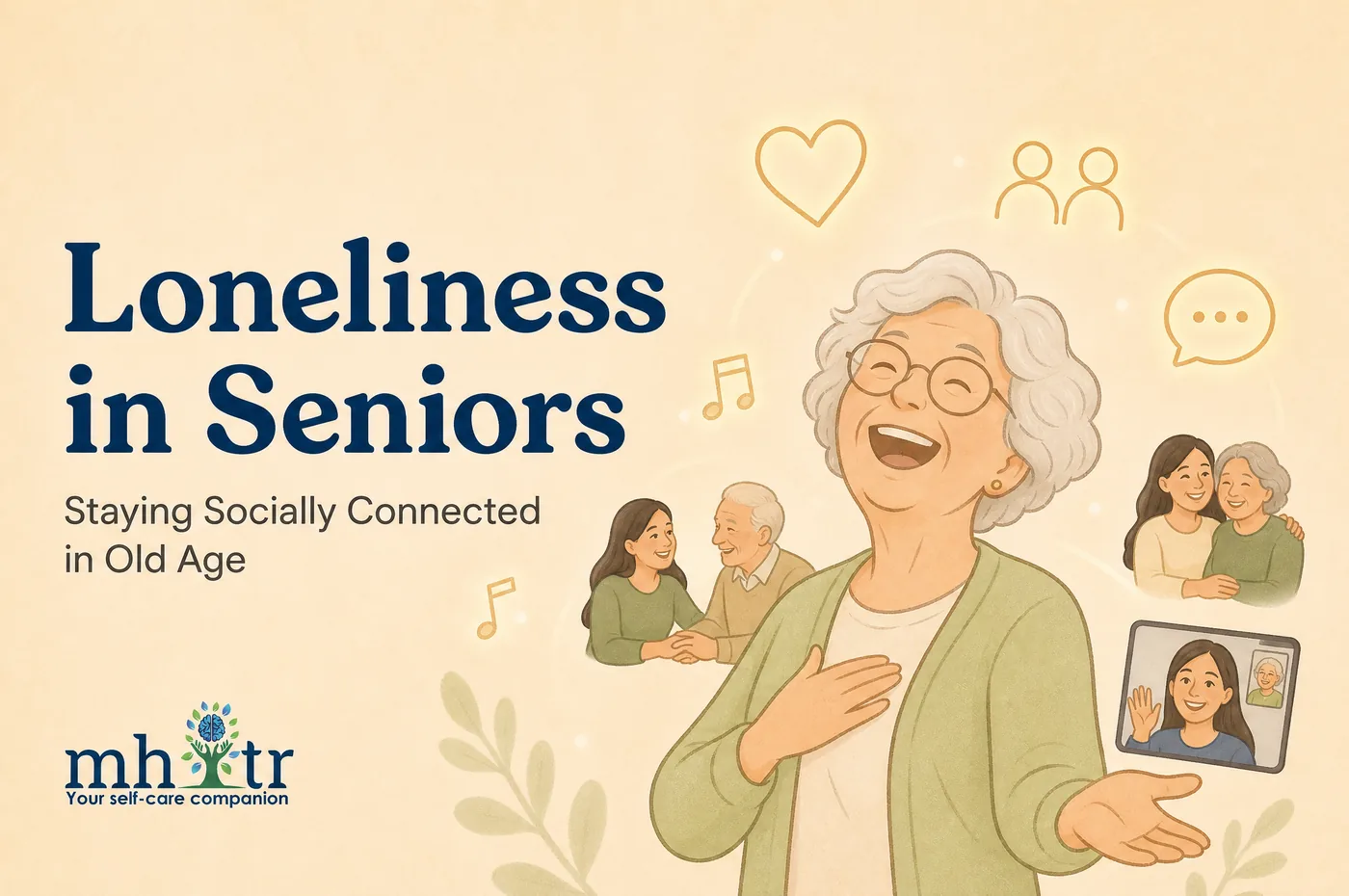
The same devices that can leave someone behind can also be the exact thing that brings them back in; if the gap is closed with a little patience instead of assumptions. A video call with a grandchild studying abroad. A voice message that doesn’t require typing. A family group chat with inclusive accessibility features.
None of this change needs turning a 70-year-old into a tech wizard. It requires treating technology as a tool for staying connected that elderly family members actually want to use.
A full house can still feel empty
This is worth sitting with, particularly in India, where the assumption is often that a joint family automatically solves the loneliness problem.
It doesn’t, certainly not automatically. Someone can live surrounded by children and grandchildren and still feel quietly absent from their own home. Everyone is busy; work, school, their own lives, and conversation shrink down to the basics: “Have you taken your medicine?” “Did you eat?” “Where are my keys?” Useful questions. Not exactly companionship.
And this is precisely where the bigger-family-equals-protected assumption needs to be retired. Mental health is a spectrum, not a headcount. A full house is not automatically a connected one, and a smaller household is not automatically a lonelier one. The real determining factor was never the number of people under one roof; it’s whether anyone in that house is actually being asked how their day went, and whether anyone stays around long enough to hear the answer.
A conversation for the global stage
Humanity is called humanity for a reason, and many social traits prove unanimous across the globe. Culture spans the global village, and this pattern doesn’t stop at any one border.
In much of Europe, family units have long trended smaller, and loneliness among older adults is reported at meaningfully high rates, even in countries with strong social welfare systems and reasonably well-connected communities. A smaller household, it turns out, doesn’t automatically produce a lonelier life, but it does remove one of the assumptions people lean on to explain the problem away.
In many parts of Africa, family and community structures often remain more communal, and reported rates of elderly loneliness tend to look different as a result; though that doesn’t mean the picture is simple, or that every household tells the same story.
In East Asia, China and Japan among them, households have been shrinking for decades, often down to two or three people, and both countries have invested heavily in researching and responding to elderly loneliness as a direct consequence of that shift.
And in the United States, where independent living and ageing-in-place are the cultural default rather than the exception, loneliness among older adults is treated as enough of a public health concern that it now sits on national health agendas in its own right.
None of this is a competition for who has it worse. It’s a reminder that big-family cultures don’t get a free pass, and small-family cultures aren’t doomed by default. Loneliness follows connection, not headcount, and connection has to be built deliberately, in every culture, every time.
How to help lonely elderly parents, without making it a project
The idea here is not requesting you to plot a grand gesture or abandon your lives to go sit beside the elderly. Depending on your situation, even the simple things in life can bring great results.
Sometimes it’s better to call instead of only texting. I don’t know about you, but I certainly prefer a call over a text. With all this youth culture and slang, texts are getting vaguer than ever before (all in the name of efficiency). A real conversation leaves room for stories, jokes, and the occasional complaint about how differently young people do everything these days.
Another mistake we make is assuming an older person won’t be interested or they aren’t capable enough. Let them be the one to decide and ask if they’d like to come along, instead of automatically deciding they’ll be too tired. Create regular moments such as a weekly trip to the park or a Sunday meal. This is far easier to sustain than a vague promise to “visit more.”
It is better to ask someone who has probably been in your very shoes about life advice rather than 3-year-old AI Chatbot LLMs. Decades of experience are sitting right there, mostly unasked-for.
It is also fair to think that you can’t be their only friend. Encourage friendships outside the family. No family, however large, can be someone’s entire social world.
And above everything else: don’t wait for someone to say the word “lonely” out loud. No one will admit that they are lonely.
The point of staying connected
The importance of social life in old age isn’t only about preventing something bad from happening later. It’s also, simply, about someone having a good Tuesday afternoon.
Is there someone they’re looking forward to seeing? Something they’re looking forward to doing? Do they feel useful, heard, included in the family’s actual life rather than just its logistics? These questions don’t show up on any clinical assessment at the doctor’s office. But they’re most of what a life well lived is actually made of.
There’s also a reason to take this seriously that goes beyond any one person’s happiness; a connection between loneliness and the ageing brain that researchers are still actively mapping. Does loneliness cause dementia? That’s a much bigger, more careful question than it first appears, and it’s something worth a separate discussion.
Related reading: cognitive decline in elderly people: meaning, early signs and causes and how happiness supports healthy ageing.
References
- World Health Organization. (2025). From loneliness to social connection: Charting a path to healthier societies. WHO report
- World Health Organization. (2025). Reducing social isolation and loneliness among older people. WHO activity page
- World Health Organization. (2025). Social connection: Questions and answers. WHO Q&A
- World Health Organization. (2025). Mental health of older adults. WHO fact sheet