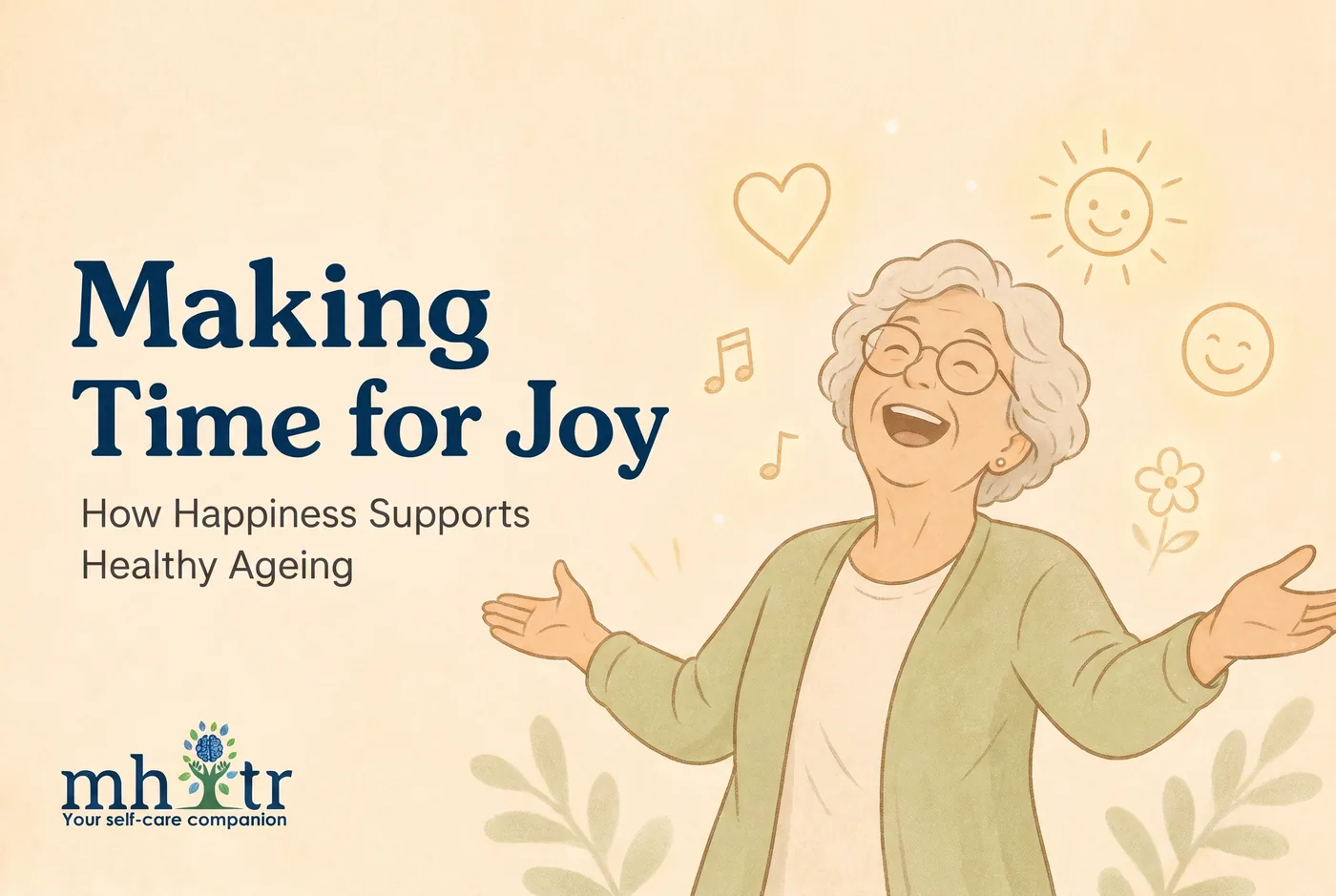
Growing older often comes with more responsibilities, more memories and, hopefully, more wisdom. Somewhere between doctor’s appointments, family responsibilities, household routines and the usual business of getting through the day, one thing we often tend to overlook is joy.
This is not about a grand display of cinematic ecstasy. Sometimes joy is a cup of tea with a loved one. It is laughing at an old story that somehow remains funny with every retelling. Maybe it is listening to a favourite song, tending to a garden, playing a game with grandchildren, or discovering something completely new. These moments seem small, but they hold the essence of life itself.
As we think about healthy ageing in India, it is worth asking the question: is the elderly individual actually happy?
Healthy ageing is about more than staying healthy
The first things that come to mind after hearing “healthy ageing” are blood pressure, diet, exercise, medication and medical check-ups. All of which matter — but health is more than physiology.
The World Health Organization describes healthy ageing in terms of maintaining the functional ability that enables well-being in older age. That includes the ability to meet basic needs, build and maintain relationships, contribute to society, and do things that matter to us.
Here is what that means. An older adult may be physically healthy and still have very little enjoyment in their daily routine. Likewise, someone living with a chronic condition can still have meaningful, enjoyable and fulfilling days. A physiological health profile only tells half the story.
This is where happiness and mental wellbeing in seniors become part of the conversation, alongside the usual territory of blood tests and step counts.
What does happiness actually do for us?
Happiness is not a medicine, and it is not to be presented as a cure for illness. But positive emotions can influence how people experience their lives, their relationships and even their health.
Research examining positive emotions in later life has found links between positive emotional experiences and health-related outcomes, although the relationship is complex and should not be reduced to “being happy makes you healthy.”
A systematic review of studies involving very old adults also found that perceived health was associated with higher life satisfaction and positive affect, while highlighting that happiness in later life is influenced by several interacting physical, psychological and social factors.
Happiness, in other words, is not the naan but the yoghurt that makes the naan moist and tender. It sits inside a much bigger picture that includes health, relationships, activity, purpose and the ability to enjoy ordinary life.
Joy does not have to be expensive
One of the most useful things about joy is that it lives in the simple things in life. For older adults, some of the most meaningful hobbies for elderly people are already close at hand, and might not cost your wallet.
A favourite song. An evening walk. A board game. Cooking something familiar. Trying a new recipe. Watching an old film with family. Growing plants. Reading. Praying or spending time in reflection. Talking to a friend. Teaching a grandchild how to make something.
None of these needs to become another health checklist, nor do they break the budget. The point is to make room for enjoyment naturally, the way it would have happened without anyone scheduling it.
For families caring for elderly parents at home, this can be simple. Instead of asking only, “Have you taken your medicine?” or “Did you do your exercises?”, sometimes ask: “What would you enjoy doing today?” That single question can open a very different kind of conversation; one of warmth and sentiment.
The social side of happiness
Most can agree that joy is better when it is shared. A joke becomes funnier when someone laughs with you. A game becomes more engaging when there is someone sitting across the table. A story gains another life when someone is interested enough to hear it.
This is because social connection is closely tied to healthy ageing. WHO identifies loneliness and social isolation as important determinants of health, and notes that meaningful social activities can improve mental health, life satisfaction and quality of life among older adults.
For families in India, this may be exceptionally relevant as household structures and lifestyles change. Older adults may live with family and still experience loneliness; being surrounded by people is not necessarily the same as feeling connected to them.
We are becoming familiar strangers.
Consider two ordinary households.
In the first home, an elderly man lives amongst eight other family members. He is cared for, fed, and healthy in every physical sense. But he spends his days perched on the balcony or sitting in isolation while the rest of the family carries on with their business. He is rarely invited to join in because the family has deemed him “too old for fun”, nor is he taken along to events because he is considered a burden to care for, or because he has no active contribution to make.
In the second home, it is just another elderly man with his daughter, son-in-law and their three-year-old son. He too is cared for in the physical sense, but his days are also spent with small purposeful roles: walking his grandson to daycare, or handling the morning trip to the local market. He looks forward to meeting his friend at the park in the evening for a cup of tea and a nice debate about politics or sport.
Both of these elderly individuals have their physical needs met, but only one is actively living his life. The difference has nothing to do with the size of the house or the number of people in it, but rather the presence of purpose, connection and everyday joy.
Movement can be joyful too
Physical activity is an important part of healthy ageing, but exercise is not punishment. Movement can be social. It can be playful. It can even become something an older adult looks forward to.
Gentle yoga, walking, stretching, dancing to familiar music or participating in an age-appropriate exercise session can help make physical activity a more enjoyable part of everyday life, and a quiet form of stress reduction for older adults who might otherwise associate exercise with obligation rather than pleasure.
WHO recommends that older adults remain physically active according to their abilities and circumstances, with physical activity contributing to physical and mental well-being and functional ability.
This is one reason programmes that combine physical activity with social and cognitive engagement can be appealing. For example, MHITR®’s Vayofit is designed for adults aged 55+ and combines physiotherapy, yoga, brain games and Ayurveda within a home-based wellness programme. The programme’s stated focus includes mobility, cognitive engagement, connection and overall well-being.
No single programme suits every older adult, but the underlying principle travels well: healthy ageing works best when physical, mental and social well-being are treated in synergy.
Making time for joy is not being idle
This deserves saying clearly. In some cases, more than desirable, the elderly are left in positions where they have to pick up extra responsibilities regardless of being old: take care of the grandchildren, help around the house, attend every family function, keep up with responsibilities, stay healthy, stay positive. There can be an invisible pressure to make every hour useful.
In all that pressure and chaos, rest and recreation are not wasted time. Neither is laughter, sitting in the sunshine, or playing a game simply because it is fun.
A 2026 systematic review of interventions designed to improve happiness in community-dwelling older adults found that a range of approaches — physical activity, psychological and relaxation techniques, artistic activities and leisure activities — were associated with improvements in happiness and well-being across the studies reviewed. There is no single prescribed activity for happiness; there are simply many legitimate ways to cultivate it.
Joy can keep the mind engaged
A crossword can be a game and a mental challenge. Learning a new song can involve memory and enjoyment. Cooking can involve creativity, coordination and sensory experience. A card game can combine strategy, memory, conversation and laughter. Even learning how to use a new piece of technology can become an opportunity for both discovery and connection.
In reality, joy is what makes the difference between cognitive games for the elderly and clinical checkups or checklists. This way, establishing a routine becomes much easier, because the senior citizens will be looking forward to the activities with happiness.
How families can make more room for happiness
In order to support an older person’s happiness, you do not have to constantly try to keep them cheerful every minute of every day. Nobody can do that. What families can do instead is create more opportunities for meaningful experiences.
Ask what they enjoy. Preferences can change with age; do not assume yesterday’s favourite activity is still today’s favourite.
Create shared rituals. A weekly card game, evening walk, tea together or Sunday lunch can give the week something to look forward to.
Make room for choice. Independence is not only about physical movement; being able to choose what to watch, eat, learn or do also contributes to a sense of autonomy.
Invite rather than insist. “Would you like to join us?” often feels very different from “You should come.”
Let them contribute. Older adults have knowledge, skills, stories and experience; give them opportunities to use them.
Keep activities accessible. A joyful activity loses some of its joy when it is physically uncomfortable, unsafe or unnecessarily difficult; activities should be adapted to the person’s abilities.
These small changes can make elderly care at home feel less like a series of tasks and more like shared living.
Finding joy in the everyday
To many, happiness is associated with a special occasion — a holiday, a birthday, a family celebration, a major achievement — and to some that is true. But healthy ageing is lived mostly on ordinary Tuesdays, and joy should also be present.
A cup of tea can be enough. A conversation can be enough. Ten minutes of music can be enough. A few stretches can be enough. A game with a grandchild can be enough. A good laugh can be enough.
Not every day can be a parade, but maybe we must learn to value the simple things in life.
A simple “joy list” for older adults
One practical idea is to create a small personal list of things that reliably bring enjoyment. Something like five favourite songs, three people they enjoy calling, a favourite meal, a favourite outdoor place, a game they enjoy, a hobby they would like to revisit, something new they would like to learn, a family tradition they enjoy, and a physical activity they feel comfortable doing.
Then, when the day feels repetitive, there is no need to invent happiness from scratch; there is already a menu, and it does not have to be complicated. Just do not use this as another mandatory checklist.
Ageing with more than years
Elderly health is based on what changes. Strength may change. Mobility may change. Daily routines change. Family roles may change. But one thing should not quietly disappear from the picture: the opportunity to enjoy being alive.
Growing old should not just constitute adding years to life. It is about making those years meaningful, connected and active in ways that suit the individual. Happiness cannot prevent every illness or solve every difficulty, but making time for joy and protecting emotional wellbeing in old age can give older adults more opportunities to connect, participate, move, learn, laugh and enjoy the people and activities that make life feel like their own.
Perhaps that is why joy deserves a place in elderly care; not as an afterthought, not as a reward for finishing everything else, but as part of the day itself. Because growing older should not mean waiting for the next appointment, the next responsibility or the next family occasion. Sometimes, healthy ageing is also knowing when to put the responsibilities down, sit back, and enjoy the moment.
References
Cheng, A., Leung, Y., & Brodaty, H. (2022). A systematic review of the associations, mediators and moderators of life satisfaction, positive affect and happiness in near-centenarians and centenarians. Aging & Mental Health, 26(4), 651–666.
Kalati, M., Rampisheh, Z., SoleimanvandiAzar, N., Shati, M., Mortazavi, S. S., & Nojomi, M. (2026). Strategies for improving happiness in older adults: A systematic review of trials. Archives of Gerontology and Geriatrics, 146, 106214.
Maximiano-Barreto, M. A., et al. (2024). Factors associated with happiness among community-dwelling older adults: A systematic review. Geriatric Nursing, 56, 124–137.
World Health Organization. (2026). Mental health of older adults. WHO fact sheet
World Health Organization. (2025). Ageing and health. WHO fact sheet
MHITR®. (n.d.). Vayofit. MHITR® Vayofit programme
MHITR®. (n.d.). Healthy ageing for seniors. MHITR® healthy ageing resources