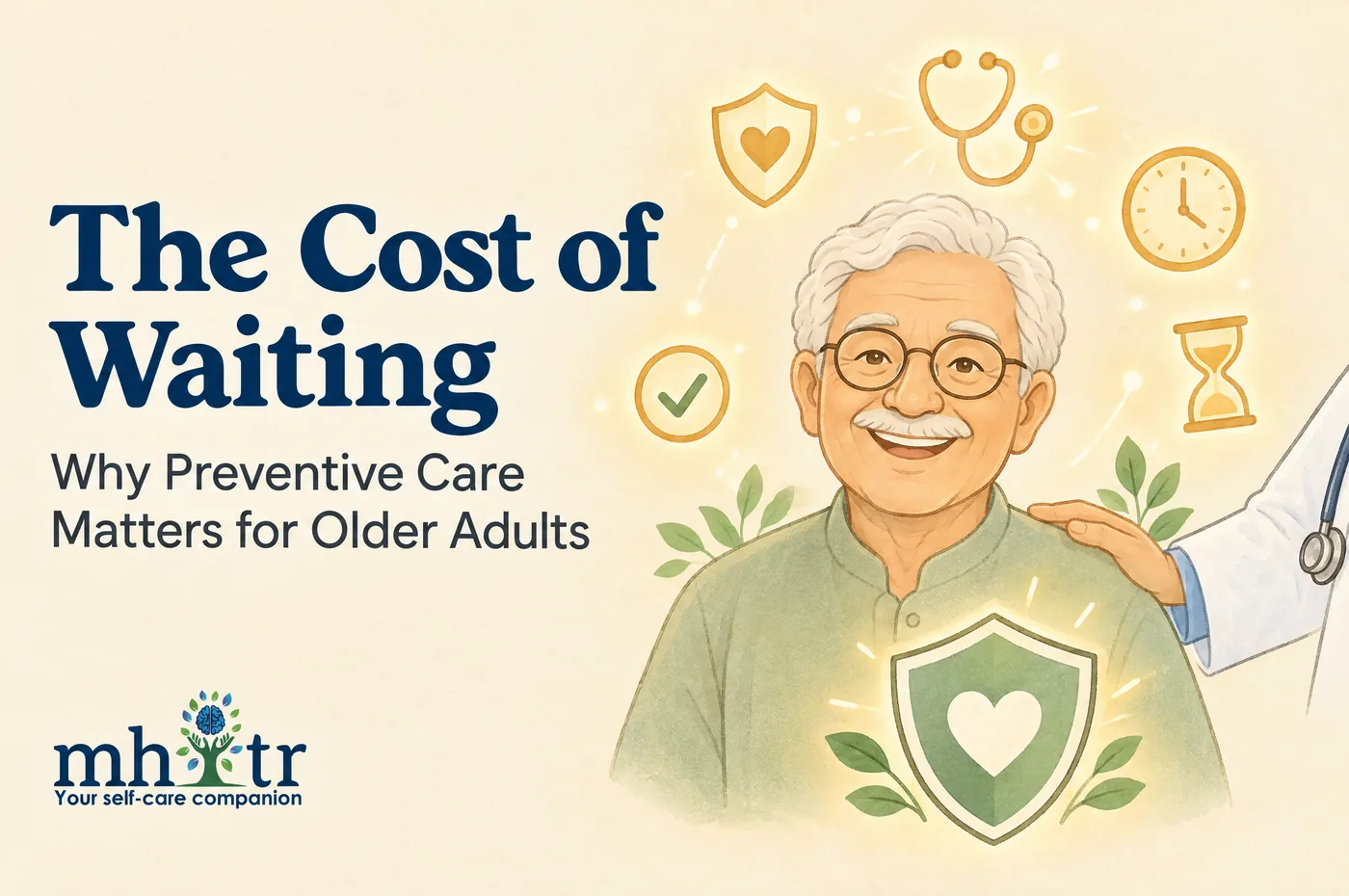
There is a familiar pattern in how families respond to an older person’s health.
A small change appears first. They’re walking a little more slowly. They’ve become less steady on the stairs. They seem to be forgetting appointments. Their medicines have become harder to keep track of. Perhaps they’re eating less, sleeping poorly, or avoiding activities they once enjoyed.
Often, nothing is done immediately. It’s easy to think, this is just part of getting older.
Sometimes it is. But sometimes a small change is the first visible sign of something that could have been assessed, managed or slowed with earlier attention. That’s where preventive care becomes a financial question as much as a medical one. Its value goes well beyond avoiding a single hospital visit. It can help preserve independence, reduce the intensity of future care, and give families more time to respond before a manageable problem becomes a major one.
The cost of waiting is larger than the medical bill
When an older adult’s health declines, the financial consequences regularly exceed one neat bill.
There may be consultation fees, medicines, diagnostic tests, physiotherapy, hospitalisation, mobility aids, transportation and eventually additional care at home. Some families may also need to pay for professional caregivers.
Then there’s a cost that never appears on a hospital invoice: time. A son may need to take several hours off work to accompany a parent to appointments. A daughter may start making daily trips across town to prepare meals or organise medicines. A spouse may gradually take over tasks the other person once handled independently.
This isn’t a minor side effect; it’s a documented labour-market cost. Research on informal caregiving consistently finds real effects on caregivers’ health and work. A systematic review found that caregiving can negatively affect caregivers’ physical and mental health, while research examining employment has found work disruptions and reduced productivity, with heavier caregiving loads linked to reduced working hours and, in some cases, withdrawal from the labour force entirely.
The economic question, therefore, is: how many hours of work and family time will this condition pull from the people around them?
Small declines can become larger care needs
Ageing involves physiological change, and older adults face increasing risks of mobility loss, falls, sensory impairment, cognitive decline, malnutrition and other shifts in physical and mental capacity. WHO’s Integrated Care for Older People approach is built specifically around detecting these changes early and preventing or slowing decline where possible.
Consider mobility. An older adult may begin feeling unsteady but continue walking around the house without assistance. If the issue is ignored and they eventually fall, the situation can escalate quickly. A fracture may require hospital care, rehabilitation and temporary or permanent assistance with everyday activities.
A fall can therefore create several problems at once: the medical problem itself, the cost of treatment, reduced independence, and additional responsibilities pulled onto the family. Falls are a particularly useful example because prevention here isn’t theoretical. Evidence reviews have found that interventions such as exercise, home assessment and medication adjustment can be cost-effective, while clinical guidance recommends assessing fall risk, reviewing medicines, and addressing strength and balance directly. One meta-analysis found that medication review specifically was associated with meaningful reductions in fall-related injuries and fractures among community-dwelling older adults.
The lesson extends well beyond falls: the earlier a change is noticed, the more options remain for responding to it, financially and otherwise.
India’s healthcare costs make the question more practical
This matters especially in a country where families often carry a substantial share of healthcare costs themselves.
The Longitudinal Ageing Study in India (LASI) found that older adults aged 60 and above who used outpatient care incurred mean out-of-pocket expenditure of ₹1,149 during the 30 days preceding the survey. For inpatient care, expenditure was substantially higher, with private-sector treatment costing considerably more than public-sector treatment in the survey data.
LASI research has also found that healthcare expenses can place households under significant financial pressure. One analysis reported that healthcare expenses were the largest cause of indebtedness in urban households and the third-largest in rural households, while only about a quarter of households had health insurance in the data examined.
These figures come from LASI Wave 1, whose data collection took place in 2017–18, so they shouldn’t be read as today’s exact prices. They’re still useful for illustrating the underlying issue: when an older person’s health problem becomes serious enough to require substantial treatment, the financial consequences extend well beyond the individual.
What preventive care actually looks like
Preventive care isn’t about sending an older adult for every test available, rather it’s about paying attention to the specific areas where early assessment and intervention can make a meaningful difference.
Depending on the person’s health and medical history, this can include:
- Regular medical reviews for existing conditions
- Medication reviews (particularly when several medicines are being taken)
- Checking vision and hearing
- Monitoring nutrition and unintended weight loss
- Assessing mobility, strength and balance
- Identifying fall hazards at home
- Maintaining appropriate physical activity
- Keeping vaccinations up to date
- Monitoring cognitive and emotional wellbeing
- Addressing new symptoms directly instead of automatically attributing them to age
The appropriate schedule differs from one person to another, and preventive care should be guided by healthcare professionals rather than treated as a universal checklist. Medication review is one good example of the underlying principle; older adults often take several medicines, and some can contribute to dizziness or falls. A relatively simple, low-cost review can be part of a much larger strategy to preserve independence and avoid far more expensive downstream care.
Prevention also protects independence
There’s another reason to think beyond medical costs.
Most families want their older relatives to remain capable of making choices, moving around safely, and participating in ordinary life for as long as possible. WHO defines healthy ageing in terms of maintaining the functional ability that enables wellbeing in older age — covering the person’s physical and mental capacities as well as the environment around them.
This changes the question a family asks about preventive care. Instead of asking: How do we treat this disease? it becomes: Can this person continue doing the things that matter to them? Can they walk safely to the neighbourhood shop? Prepare a meal? Manage their medicines? Meet friends? Move around their home without fear of falling?
Maintaining those abilities may require surprisingly ordinary interventions: appropriate exercise, a medication review, better lighting, treatment for a vision problem, nutritional support, or timely management of a chronic condition.
Early action is not predicting the future
Preventive care can’t stop ageing, and it can’t guarantee a serious illness will never occur. That distinction matters. The purpose is to identify risks while there’s still room to act.
A family doesn’t need to wait until an older parent falls before asking whether their balance has changed. They don’t need to wait until several medicines are being taken incorrectly before reviewing the medication routine. They don’t need to wait until someone becomes significantly isolated before asking how they’re coping.
WHO’s current ICOPE guidance recommends person-centred assessment in primary care specifically to detect declines in intrinsic capacity, identify health and social care needs, and develop personalised care plans early. That’s essentially what early action looks like: observe, assess, respond, follow up.
The real saving may be measured in time
It’s tempting to think of preventive healthcare as another expense added to a family’s budget. There’s a more accurate way to look at it.
A consultation, assessment or supervised exercise programme requires money and time today. But if it helps an older person remain mobile, manage a health problem, or avoid a preventable complication, the benefit compounds well beyond that single appointment — fewer emergency visits, fewer days spent organising care, fewer workdays interrupted, fewer decisions made in a crisis. And perhaps most importantly, more time spent living with independence rather than depending on others for tasks they once handled themselves.
That’s the real cost of waiting. The price isn’t always initially clear, and sometimes it’s paid gradually, through lost independence, family time, work, repeated caregiving, and choices that narrow as a problem progresses.
Preventive care can’t remove every difficulty that comes with ageing. What it offers instead is a chance for families to respond while the situation is still manageable. For older adults, that can mean preserving function. For families, it can mean preserving time. And for both, early attention may be one of the more practical financial decisions they make in the years ahead.
References
- World Health Organization. (2025). Integrated care for older people (ICOPE): Guidance for person-centred assessment and pathways in primary care, 2nd ed. WHO
- World Health Organization. (2017). Integrated care for older people: Guidelines on community-level interventions to manage declines in intrinsic capacity. WHO
- International Institute for Population Sciences (IIPS). (2020). Longitudinal Ageing Study in India (LASI), Wave 1: India Executive Summary. LASI
- United Nations Population Fund (UNFPA) India & IIPS. (2023). Caring for Our Elders: Institutional Responses — India Ageing Report 2023. UNFPA India
- Ming, Y., Zecevic, A. A., Hunter, S. W., Miao, W., & Tirona, R. G. (2021). Medication review in preventing older adults’ fall-related injury: A systematic review & meta-analysis. Canadian Geriatrics Journal, 24(3), 237–250. DOI
- Bom, J., Bakx, P., Schut, F., & van Doorslaer, E. (2019). The impact of informal caregiving for older adults on the health of various types of caregivers: A systematic review. The Gerontologist, 59(5), e629–e642. PubMed record
- Lilly, M. B., Laporte, A., & Coyte, P. C. (2007). Labor market work and home care’s unpaid caregivers: A systematic review of labor force participation rates, predictors of labor market withdrawal, and hours of work. The Milbank Quarterly, 85(4), 641–690. PubMed record