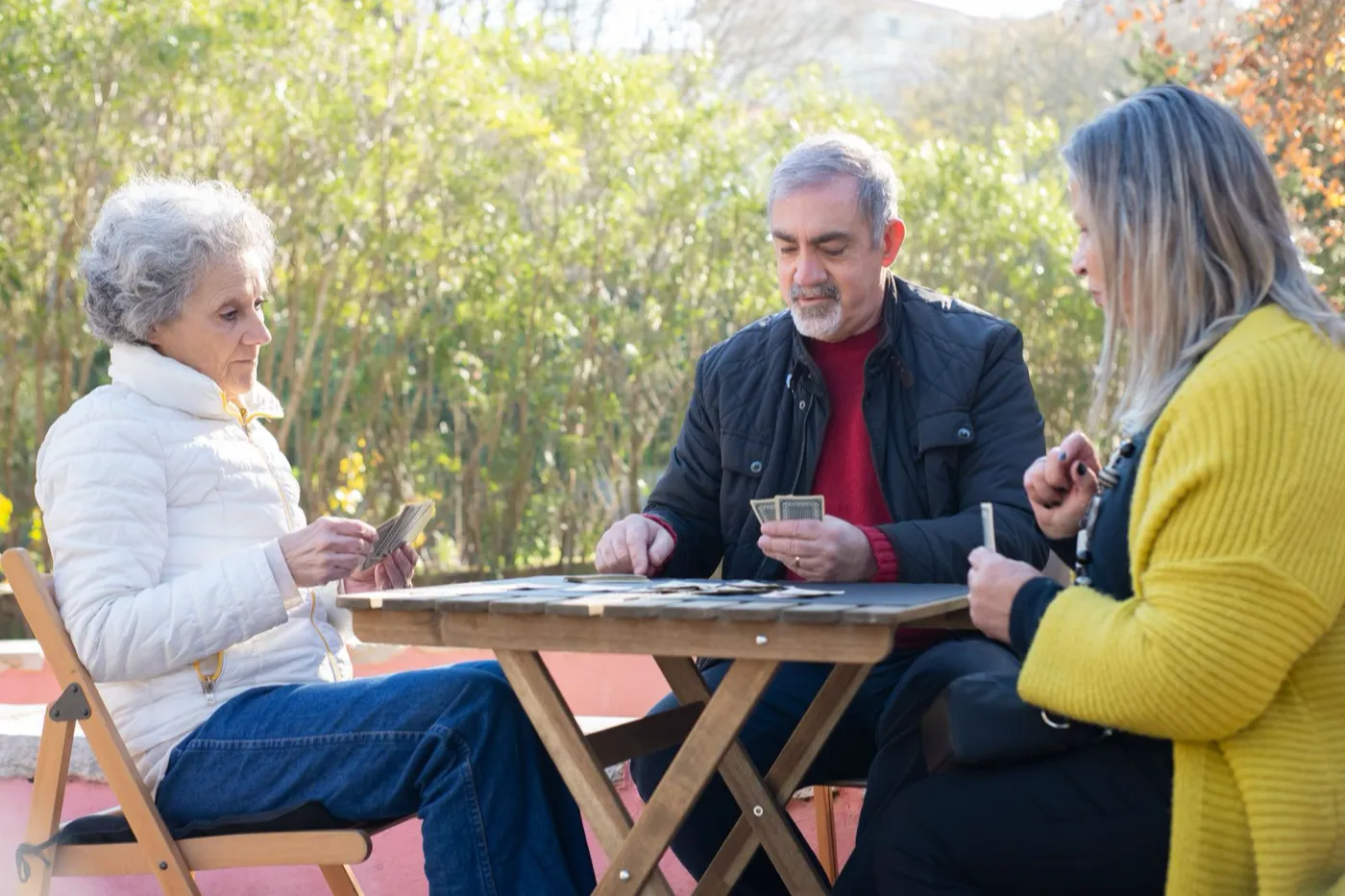
A good board game can turn an ordinary afternoon into shared time with family. It creates space for conversation, light competition, problem-solving and laughter. For older adults, games and puzzles also offer regular chances to practise attention, memory and reasoning.
Choosing the right game becomes more important when someone has arthritis, reduced hand strength or poor eyesight. Small cards, tiny puzzle pieces and fiddly components can make an activity unnecessarily difficult. The answer is not to stop playing, but rather to find games that are comfortable to handle, easy to see and enjoyable at the person’s own pace.
If you are looking for board games for seniors, this guide covers practical options, accessibility features and simple adaptations that make game time more inclusive. For a wider list of screen-free ideas, see our guide to 25 brain games for seniors.
What Makes a Board Game Suitable for Older Adults?
Two practical factors matter most: how easily someone can see the game and how comfortably they can handle it.
For seniors with arthritis or stiff hands, look for:
- Larger pieces that are easy to pick up
- Lightweight components that do not require excessive force
- Smooth edges and comfortable shapes
- Pieces that can be moved without tight pinching
- Boards that stay stable during play
Arthritis can make prolonged gripping and repetitive pinching uncomfortable. Guidance on joint protection from the Arthritis Movement and Mayo Clinic recommends reducing unnecessary strain, using larger or adapted grips where helpful, taking breaks, and avoiding activities that aggravate joint pain.
For seniors with poor eyesight, look for:
- Large, clearly printed numbers and letters
- Strong contrast between pieces and the board
- Clear symbols rather than intricate designs
- Larger playing surfaces
- Good lighting and minimal visual clutter
Low vision does not mean traditional games have to stop. As the RNIB and the Wisconsin Council of the Blind & Visually Impaired point out, large-print cards, tactile pieces, high-contrast colours and simple adjustments can help people continue enjoying familiar activities.
8 Board Games and Puzzles Worth Considering
These options work well for different preferences and abilities. Treat them as a starting point rather than a fixed ranking.
1. Large-print playing cards
Card games are familiar, flexible and easy to play with family. Rummy, Go Fish and simple matching games can be adapted to different levels of difficulty. Jumbo-index cards with large numbers and suit symbols help with vision. Card holders can assist people who struggle to hold several cards at once.
Best for: Social games and familiar card activities.
2. Large-piece dominoes
Dominoes are straightforward to learn and can be played alone or in a group. Choose larger tiles with clearly defined dots and strong colour contrast. Raised dots offer an extra tactile reference for significant visual impairment.
Best for: Simple rules and relaxed social play.
3. Ludo with larger pieces
Ludo is a familiar favourite in many Indian households and works well across generations. Choose a board with clearly marked squares and larger playing pieces that are easy to pick up and place. A larger, lightweight die or a dice shaker can also help.
Best for: Family game nights and multigenerational participation.
4. Chess and draughts
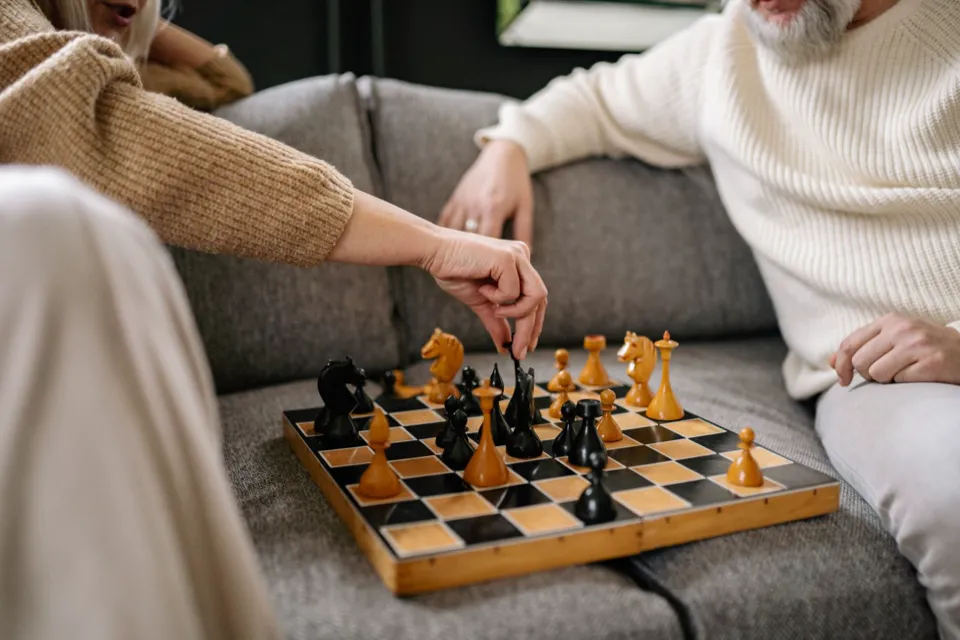
These games involve planning, attention and decision-making. Look for larger boards with contrasting squares and clearly distinguishable pieces. Magnetic or pegged pieces help prevent accidental movement. Larger pieces with a stable base are easier for hands that fatigue quickly.
Best for: Strategy and players who already know the games.
5. Large-print Scrabble
Word games practise vocabulary and language skills. Larger letter tiles and a board with clearly visible squares make a difference. A non-slip surface helps keep pieces in place. If the full game feels demanding, a simpler word-building activity with large letter cards works well.
Best for: Language, spelling and word challenges.
6. Large-piece jigsaw puzzles
Jigsaws involve visual recognition, spatial reasoning and problem-solving. Avoid puzzles with hundreds of tiny pieces and subtle colour differences. Choose fewer, larger pieces with clear images and strong contrast. Familiar subjects (landscapes, flowers, animals, Indian monuments) often feel more enjoyable.
Best for: Quiet independent activity or working together with a family member.
7. Large-piece wooden shape puzzles
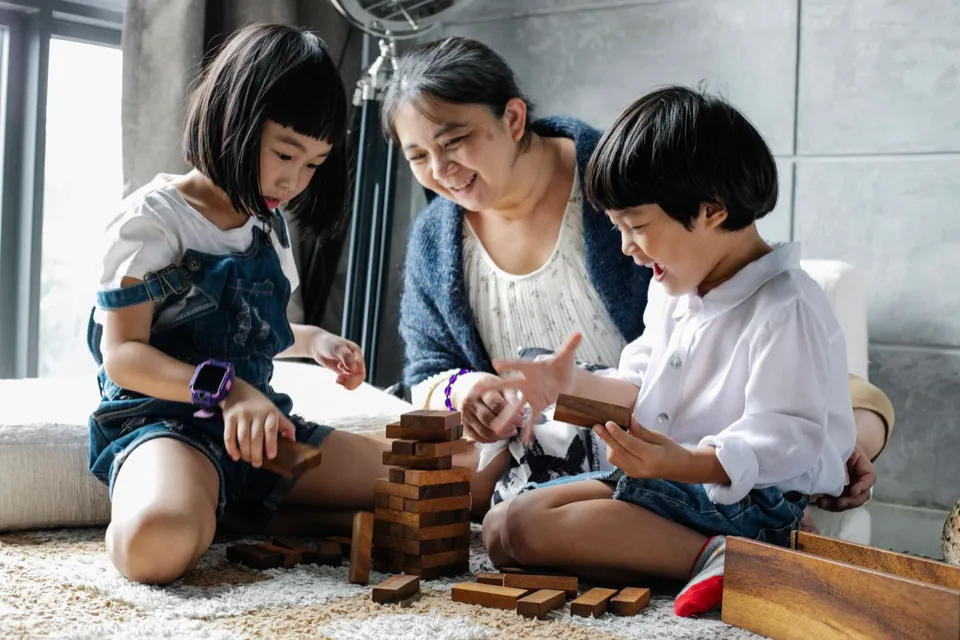
Shape-matching and wooden logic puzzles offer a tactile alternative to traditional board games. Look for thick, lightweight pieces that are easy to grasp, with distinct shapes and colours. Avoid designs that require excessive pressure, precise finger movements or repeated twisting. Start with fewer pieces and add more as comfort allows.
Best for: Tactile activities and visual problem-solving.
8. Large-print Sudoku and crosswords
Not every puzzle needs a board. Large-grid Sudoku and crossword books suit people who enjoy independent challenges. Choose bold printing and generous spacing. A thick-barrelled pen or pencil grip can make writing more comfortable. If writing is difficult, a family member can read the clues and record the answers.
Best for: Numbers, language and independent mental activity.
Wondering whether these beat brain-training apps? Our comparison of online apps and physical games for seniors looks at the trade-offs.
How to Adapt Games You Already Own
Sometimes the most accessible game is one already in the house. A few simple changes can make a familiar activity much easier.
Common difficulty | Practical adaptation |
|---|---|
Small pieces hard to grip | Choose larger pieces or use a card holder |
Fingers become painful | Take breaks; avoid prolonged tight gripping |
Pieces blend into the board | Use high-contrast colours and a plain background |
Cards difficult to read | Switch to jumbo-index cards |
Poor lighting | Use a well-positioned adjustable lamp |
Pieces slide around | Try a non-slip mat or magnetic board |
Writing causes discomfort | Use a thick-barrelled pen or adapted grip |
These adjustments align with guidance from organisations that support people with arthritis and visual impairment.
Additional practical points:
- Let the player choose what they enjoy.
- Avoid unnecessary time pressure.
- Keep the playing area comfortable (stable table, supportive chair).
- Stop or modify an activity if it causes pain.
- Make the rules flexible if strict scoring reduces enjoyment.
If you are planning games for a larger group rather than one person, our list of indoor games for senior citizens covers kitty parties, societies and senior living communities.
Bringing Structure with the Vayofit Wellness Kit
Buying a single game is the easy part. Maintaining variety and making activities part of a regular routine is often harder.
MHITR®’s Vayofit Wellness Kit is a screen-free cognitive activity kit designed for adults aged 55 and above. It includes physical games and materials across memory and recall, orientation, arithmetic, language, reasoning and mindfulness. It can be used at home or in group settings.
Many of its components are wooden and larger than typical shop-bought pieces, which can make them easier to handle for people with reduced grip strength or low vision. Suitability still depends on the individual activity and the person’s abilities. Families should check size, weight, grip requirements and visual contrast before use.
The kit is not a medical or diagnostic device. Its purpose is everyday wellness and engagement, not the treatment of arthritis, visual impairment or cognitive disorders. You can explore the Vayofit Wellness Kit to see the activities and available options.
The Best Game Is the One They Enjoy Playing
Ageing does not mean giving up the activities that make life enjoyable. A change in eyesight or hand mobility may require a different board, larger pieces or a few adjustments, but it does not have to end game nights.
Whether it is a family Ludo match, a game of cards, a wooden puzzle or a crossword over morning tea, the value lies in participation.
Choose games that respect comfort, preserve independence and encourage connection. The point is not simply to keep the mind occupied. It is to make room for enjoyment, challenge and time spent together. For more ideas, explore our healthy ageing guides.
Frequently asked questions
What makes a board game suitable for seniors?
Two things matter most: how easily the person can see the game and how comfortably they can handle it. Look for larger, lightweight pieces that don’t need tight pinching, boards that stay stable, large clear print, strong contrast between pieces and board, and good lighting.
What are good board games for seniors with arthritis?
Games with larger, lightweight pieces that can be moved without tight gripping: large-piece dominoes, Ludo with larger pieces, chess with stable or pegged pieces and wooden shape puzzles. A card holder helps with card games, and a thick-barrelled pen helps with puzzle books. Take breaks and stop if an activity causes pain.
Which games work for seniors with poor eyesight?
Jumbo-index playing cards, dominoes with clearly defined or raised dots, large-print Scrabble, jigsaws with fewer, larger pieces and strong contrast, and large-grid Sudoku and crosswords. A well-positioned lamp and a plain, uncluttered background also help.
How can I adapt games we already own for an older parent?
Use a card holder for small cards, a non-slip mat or magnetic board for pieces that slide, high-contrast colours and a plain background, better lighting and an adapted pen grip. Remove time pressure and relax the scoring rules if they reduce enjoyment.